
Artificial intelligence failures are no longer treated as technical mishaps. They are now legal, financial, and reputational events with consequences measured in millions of euros. Over the past few years, regulators have moved decisively from issuing guidance to imposing penalties, and organizations deploying AI systems are discovering that non-compliance is far more expensive than anticipated.
Across Europe and beyond, enforcement actions related to AI-driven systems have resulted in record-breaking fines, class-action lawsuits, forced product withdrawals, and long-term brand damage. These outcomes are not limited to reckless startups or experimental tools. They affect global enterprises, trusted platforms, and organizations that believed their compliance posture was “good enough.”
This shift marks a turning point. AI governance is no longer a future concern or a theoretical risk. It is an operational reality that boards, executives, and compliance teams must address today. With the EU AI Act introducing severe penalties for non-compliance, including fines of up to 7 percent of global annual turnover, the financial exposure associated with poorly governed AI systems is becoming impossible to ignore.
The real cost of AI non-compliance, however, extends far beyond headline fines. Legal defense expenses, internal investigations, delayed deployments, lost contracts, customer churn, and reputational recovery often multiply the initial penalty several times over. In many cases, the indirect costs eclipse the regulatory fine itself.
This article examines real-world case studies that illustrate how AI non-compliance leads to financial penalties and lasting reputational damage. It looks at biased hiring algorithms, unlawful data practices, and AI system failures that triggered regulatory action and public backlash. The goal is not to sensationalize these incidents, but to understand their impact and extract practical lessons for organizations deploying AI at scale.
As enforcement accelerates and regulatory expectations become clearer, organizations face a simple choice. They can invest proactively in governance, risk management, and technical controls, or they can wait and risk becoming the next case study. The examples that follow show why waiting is the more expensive option.
The New Era of AI Regulation and the Size of Potential Fines
AI regulation has entered a new phase. What began as ethical guidelines and voluntary frameworks has evolved into binding legal obligations with meaningful financial consequences. The EU AI Act represents the most comprehensive attempt to regulate artificial intelligence to date, and it fundamentally changes the risk calculus for organizations deploying AI systems.
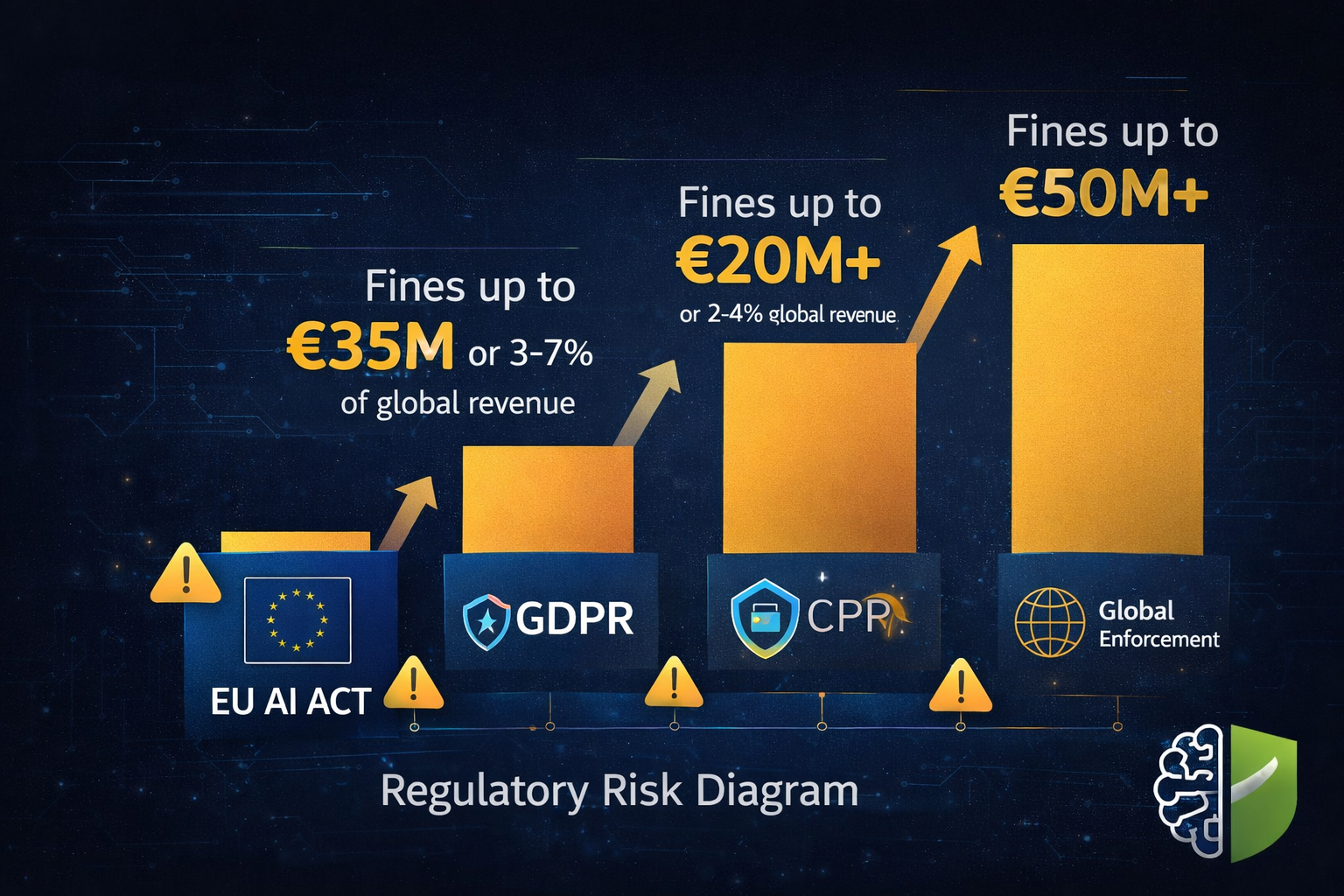
Under the EU AI Act, penalties are tiered according to the severity of the violation. The most serious breaches, including the use of prohibited AI practices, can result in fines of up to €35 million or up to 7 percent of global annual turnover, whichever is higher. Violations related to high-risk AI system obligations can trigger penalties of up to €15 million or 3 percent of turnover. Even failures to meet transparency or information obligations can result in significant sanctions.
These penalties do not exist in isolation. AI systems frequently rely on personal data, automated decision-making, and profiling, which brings them squarely within the scope of existing data protection and anti-discrimination laws. As a result, a single AI deployment can expose an organization to multiple overlapping enforcement regimes, including GDPR, consumer protection rules, and sector-specific regulations.
The regulatory timeline reinforces the urgency. Certain AI practices have already been restricted, and obligations for general-purpose AI models and systemic risk controls are taking effect ahead of the full enforcement of high-risk AI system requirements. By the time high-risk obligations become fully enforceable, regulators will have years of experience applying penalties under adjacent legal frameworks.
This means that organizations should not assume a “grace period” or a lenient enforcement approach. Past experience with GDPR demonstrates the opposite pattern. Early enforcement actions set precedents, and penalties tend to increase as regulators gain confidence and political support. AI non-compliance fines are expected to follow a similar trajectory.
The global implications extend beyond Europe. In other jurisdictions, AI-related harms are increasingly addressed through discrimination law, consumer protection enforcement, and civil litigation. Lawsuits alleging biased automated decision-making, misleading AI outputs, or unlawful data use are becoming more common, and they often attract significant media attention.
For multinational organizations, this creates a compounded risk environment. A single AI system can trigger regulatory action in multiple jurisdictions, generate class-action lawsuits, and attract scrutiny from advocacy groups and the press. The financial exposure grows rapidly when these factors combine.
The key takeaway is that AI non-compliance fines represent only the visible portion of the risk. They are the most quantifiable consequence, but not the most damaging one. To understand the full cost of non-compliance, it is necessary to examine how specific AI failures translate into lawsuits, public backlash, and long-term loss of trust. The following case studies illustrate how quickly these dynamics unfold.
Case Study: Reputational and Legal Damage from Biased AI Hiring Systems

Few areas illustrate the cost of AI non-compliance more clearly than automated hiring and recruitment systems. These tools are often marketed as objective, efficient, and scalable alternatives to human decision-making. In practice, poorly governed hiring algorithms have repeatedly produced biased outcomes that expose organizations to lawsuits, regulatory scrutiny, and lasting reputational harm.
One of the most frequently cited examples remains the internal hiring tool developed by a major technology company that was ultimately abandoned after it was found to disadvantage female candidates. The system learned patterns from historical hiring data that reflected a male-dominated workforce and replicated those biases at scale. While the tool was never publicly deployed, the revelation itself became a cautionary tale that continues to shape regulatory and public expectations.
More recent cases demonstrate that the problem did not end there. Automated screening and ranking tools used in recruitment have been challenged in court on the grounds that they discriminate on the basis of race, age, disability, and other protected characteristics. These challenges are not abstract ethical debates. They are legal claims grounded in employment law, anti-discrimination statutes, and equal opportunity regulations.
In several high-profile lawsuits, plaintiffs have argued that algorithmic hiring systems systematically excluded qualified candidates without meaningful transparency or recourse. Courts have shown increasing willingness to allow these claims to proceed, recognizing that automated decision-making does not absolve organizations of responsibility for discriminatory outcomes. In some cases, collective actions have been certified, significantly increasing potential financial exposure.
Beyond the courtroom, the reputational consequences of biased AI hiring systems can be severe. Organizations accused of algorithmic discrimination often face intense media scrutiny, public criticism from civil rights groups, and loss of trust among job seekers. Even when cases are eventually settled or dismissed, the reputational damage can persist long after the legal process concludes.
The operational impact is equally significant. Companies facing bias allegations frequently pause or abandon automated hiring initiatives altogether. This results in wasted development costs, delayed recruitment processes, and internal disruption as teams scramble to replace or redesign systems under pressure. In competitive talent markets, these disruptions can have a direct impact on productivity and growth.
From a regulatory perspective, these cases highlight why employment-related AI systems are classified as high-risk under the EU AI Act. Hiring decisions directly affect individuals’ access to employment and economic opportunity. As a result, regulators expect strong controls around data quality, bias mitigation, transparency, and human oversight.
The financial costs associated with biased hiring algorithms extend well beyond settlements or fines. Legal defense costs can run into millions of euros, particularly in multi-year litigation. Internal audits, external reviews, and mandated remediation programs add further expense. In some cases, organizations also incur significant costs to rebuild trust with candidates and regulators.
Perhaps the most damaging consequence is the erosion of employer brand. Trust, once lost, is difficult to restore. Candidates who believe an organization uses unfair or opaque AI systems may simply choose not to apply, shrinking the talent pool and undermining diversity initiatives. For organizations that rely on reputation to attract skilled workers, this can become a long-term strategic disadvantage.
The lesson from these cases is clear. Bias in AI systems is not merely a technical flaw or a public relations issue. It is a compliance failure with tangible legal and financial consequences. As enforcement under the EU AI Act intensifies, organizations that deploy AI in hiring without robust governance controls are exposing themselves to risks that far outweigh any short-term efficiency gains.
While biased hiring systems demonstrate how AI can damage reputation and invite litigation, other cases show how data misuse and unlawful AI practices can trigger some of the largest regulatory fines seen to date. These examples offer a preview of the enforcement environment organizations can expect as AI regulation matures.
Case Study: Financial Fines for Data Misuse and Unlawful AI Practices

If biased hiring systems illustrate the reputational cost of AI non-compliance, large-scale data misuse cases reveal its direct financial impact. Over the past few years, regulators have imposed substantial fines on organizations that deployed AI systems without lawful data practices, transparency, or adequate safeguards. These cases are particularly instructive because they demonstrate how existing data protection laws are already being used to penalize AI misuse, even before full enforcement of the EU AI Act.
One of the most widely cited examples involves facial recognition technology built on unlawfully collected biometric data. Multiple regulators across Europe concluded that scraping images from the internet to build massive facial databases violated fundamental data protection principles. Fines issued in different jurisdictions reached into the tens of millions of euros, accompanied by orders to delete data and cease processing activities entirely.
The financial impact of these decisions extended beyond the headline fines. Companies were forced to dismantle core components of their products, withdraw from key markets, and absorb the cost of compliance remediation under intense regulatory scrutiny. For organizations built around AI-driven data processing, these enforcement actions effectively undermined their business models.
Another landmark case involved a widely used generative AI system that regulators found lacked a valid legal basis for certain data processing activities and failed to meet transparency obligations. Authorities cited insufficient disclosure, inadequate safeguards for minors, and unclear data usage practices. The resulting fine, while significant on its own, was accompanied by mandatory corrective measures that required substantial engineering and governance changes.
These cases demonstrate a critical point: AI non-compliance rarely results in a simple financial penalty followed by business as usual. Regulatory actions often trigger long-term operational consequences, including forced redesigns, deployment delays, and heightened oversight. In many cases, the cost of compliance after enforcement far exceeds the original fine.
High-profile enforcement actions against large digital platforms further reinforce this pattern. Regulators have imposed record-breaking penalties for unlawful profiling, insufficient consent mechanisms, and security failures linked to algorithmic systems. These decisions make clear that AI systems are not exempt from data protection law simply because they rely on complex models or automated processes.
From a strategic perspective, these fines serve as early indicators of how AI-related enforcement is likely to evolve. Regulators are no longer satisfied with abstract assurances about innovation or complexity. They expect demonstrable compliance, clear documentation, and accountability throughout the AI lifecycle. Organizations that cannot provide this evidence are increasingly exposed to enforcement action.
Importantly, these financial penalties occurred under existing legal frameworks. As the EU AI Act becomes fully enforceable for high-risk systems, the potential scale of fines will increase further. Penalties tied to global turnover introduce a level of financial exposure that can materially affect even the largest organizations.
The message from regulators is consistent. AI systems that process personal data must comply with established legal principles, regardless of novelty or technical sophistication. Failure to do so invites not only fines, but also mandatory changes that can disrupt operations and erode competitive advantage.
While headline fines capture attention, they represent only a fraction of the true cost of AI non-compliance. In many cases, the most damaging consequences are less visible but far more enduring.
To understand the full financial and strategic impact of AI non-compliance, it is necessary to look beyond penalties alone and examine the hidden costs that follow regulatory intervention.
The Hidden Costs of AI Non-Compliance: Legal, Operational, and Reputational Damage
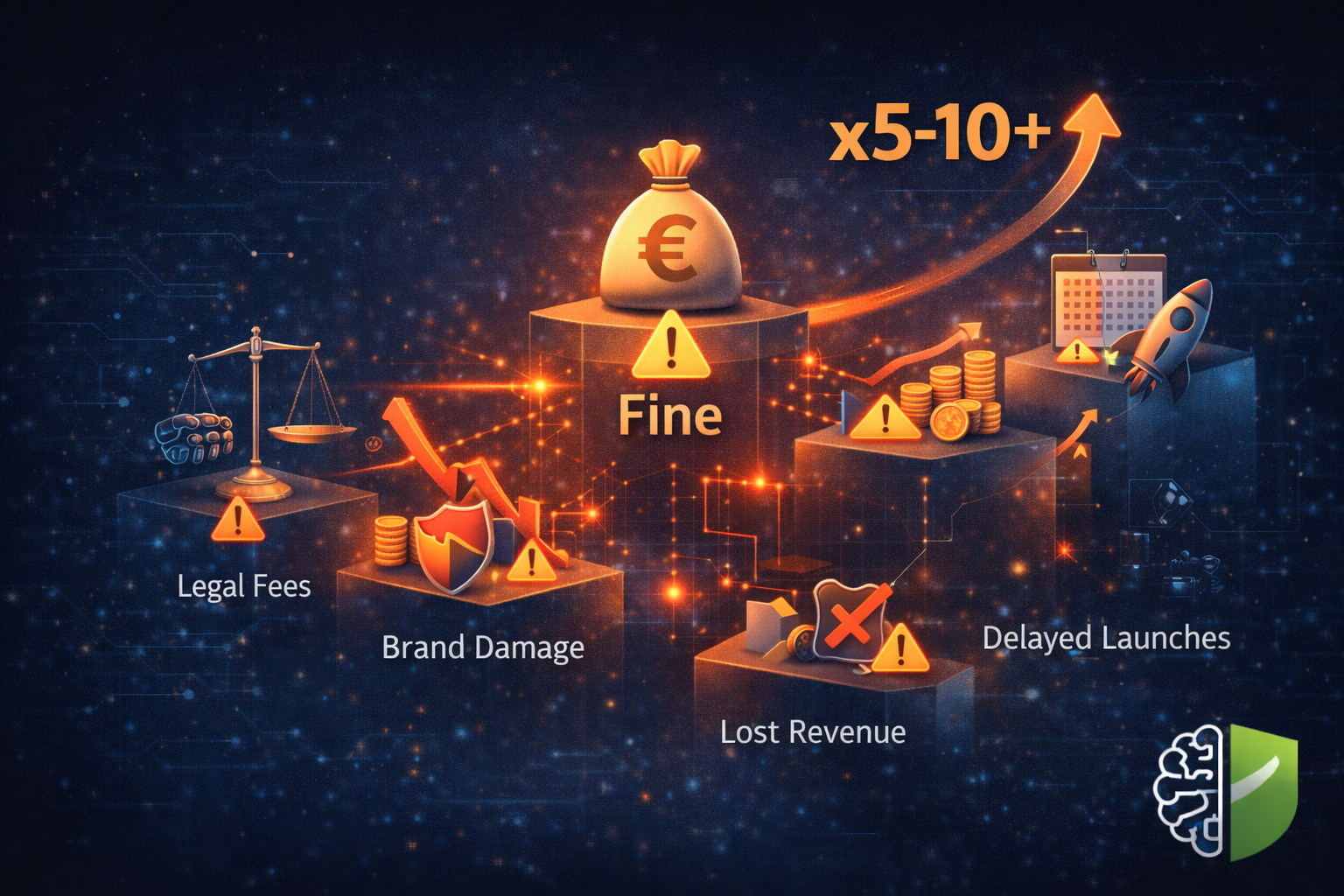
When organizations assess the risk of AI non-compliance, they often focus narrowly on regulatory fines. While these penalties can be substantial, they rarely represent the true cost of failure. In practice, the financial and operational consequences that follow enforcement actions frequently outweigh the fine itself by several multiples.
Legal costs are usually the first hidden expense to surface. Regulatory investigations trigger prolonged engagement with external counsel, forensic auditors, technical experts, and compliance consultants. These efforts can stretch over months or even years, with costs quickly reaching millions. Unlike one-time fines, legal and advisory expenses accumulate continuously as investigations evolve.
Operational disruption is another significant and often underestimated consequence. When regulators identify deficiencies in an AI system, organizations may be required to suspend deployments, limit functionality, or withdraw products from certain markets. For AI-driven services embedded deeply into business operations, these interruptions can halt revenue streams and delay strategic initiatives.
In some cases, enforcement actions force organizations to rebuild models, retrain systems, or redesign data pipelines under regulatory supervision. These remediation efforts consume engineering resources that would otherwise be focused on innovation. Product roadmaps are delayed, technical debt increases, and internal teams are diverted into crisis response mode.
Reputational damage compounds these challenges. Public enforcement actions attract media scrutiny, stakeholder concern, and heightened attention from civil society groups. Customers may lose confidence in the organization’s ability to deploy AI responsibly, while partners reassess their willingness to integrate or rely on affected systems.
Trust erosion is particularly costly in regulated or high-stakes sectors. Financial institutions, healthcare providers, and employers rely heavily on credibility and reliability. Once an organization becomes associated with biased algorithms, unlawful data practices, or AI-related harm, restoring trust can require sustained investment in transparency, governance, and external assurance.
Market reactions often reflect this loss of confidence. Enforcement announcements can coincide with declines in share price, increased customer churn, and reduced adoption of AI-enabled products. While these impacts are difficult to attribute precisely, they represent real economic consequences that persist long after fines are paid.
Another hidden cost is increased regulatory scrutiny going forward. Organizations that experience enforcement actions often find themselves subject to more frequent audits, reporting obligations, and oversight. This heightened scrutiny raises ongoing compliance costs and limits flexibility in deploying new AI capabilities.
These downstream effects illustrate why AI non-compliance is best understood as a systemic business risk rather than a discrete legal issue. The financial penalty may close one chapter, but the operational, reputational, and strategic consequences can shape an organization’s trajectory for years.
As regulatory expectations around AI continue to mature, these hidden costs are likely to increase. Enforcement actions will not only penalize past failures but also influence how regulators assess future deployments. Organizations that wait until after an incident occurs face a much steeper and more expensive recovery path.
The cases examined so far point to a clear conclusion. Reactive compliance is far more costly than proactive governance. Avoiding fines is important, but avoiding disruption, loss of trust, and long-term oversight is even more critical.
The next question, then, is not whether organizations should invest in AI governance, but how they can do so effectively before becoming the next cautionary tale.
The Solution: Proactive AI Governance Before Regulators Act
The case studies and enforcement actions discussed so far point to a single, consistent lesson. Organizations that treat AI compliance as a reactive exercise pay far more than those that embed governance early. The cost of AI non-compliance is not inevitable. In most cases, it is the result of delayed action, fragmented ownership, or overreliance on assumptions that regulators will intervene slowly.
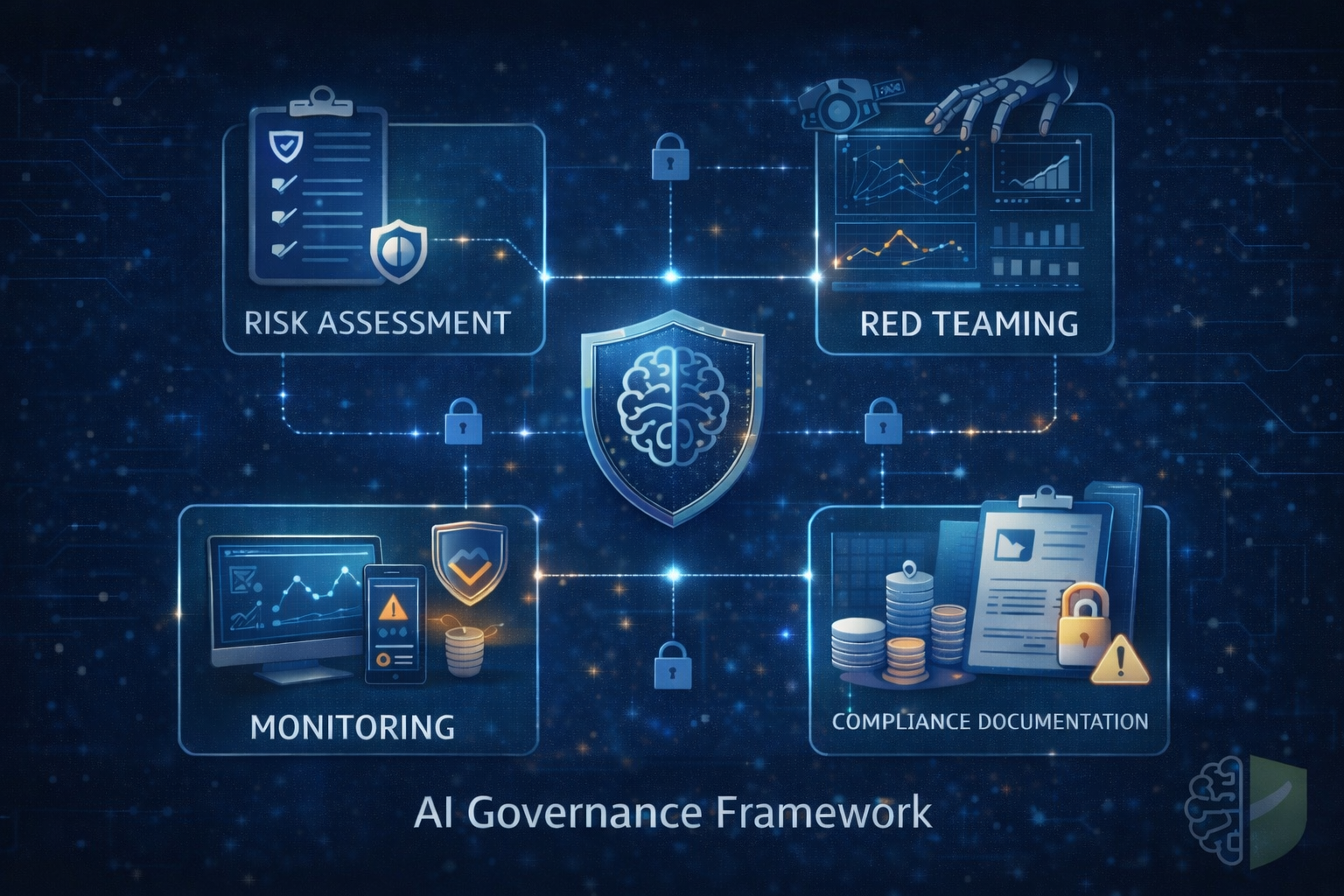
Proactive AI governance starts with understanding risk classification. Not every system carries the same exposure, but high-risk AI systems demand heightened controls across data governance, robustness, transparency, and human oversight. Organizations that clearly identify which systems fall into higher-risk categories are able to prioritize resources and prevent compliance gaps from compounding unnoticed.
Data governance is a foundational pillar of prevention. Many of the largest fines and reputational failures trace back to inadequate control over training data, weak documentation, or lack of traceability. Establishing clear data lineage, bias assessment procedures, and evidence retention practices enables organizations to demonstrate compliance rather than merely assert it.
Robustness and security controls form the second critical layer. As discussed in earlier articles in this series, adversarial testing and AI red teaming are no longer optional for serious AI deployments. Testing systems under hostile and unexpected conditions reveals weaknesses before they are exploited by users, attackers, or regulators. More importantly, it produces documented evidence that appropriate robustness measures were applied.
Human oversight and accountability complete the governance framework. Regulators consistently emphasize that AI systems must not operate in isolation from meaningful human control. Clear escalation paths, override mechanisms, and ownership structures reduce both legal exposure and operational risk. When failures occur, accountability is already defined rather than improvised.
Organizations that invest in these controls early gain more than regulatory protection. They build internal confidence, improve decision-making quality, and create systems that degrade more predictably under stress. Over time, governance becomes an enabler of scale rather than a barrier to innovation.
Most importantly, proactive governance changes the organization’s posture with regulators. Instead of reacting defensively to enforcement actions, organizations can demonstrate that risks were identified, tested, and mitigated in advance. This distinction often determines whether an incident becomes a manageable compliance issue or a public case study.
The cost of AI non-compliance is escalating, but so is the clarity of what regulators expect. The organizations that succeed will be those that act before enforcement deadlines force rushed and expensive remediation.
Conclusion: Don’t Become the Next AI Non-Compliance Case Study
The financial penalties, lawsuits, and reputational damage outlined in this article are not edge cases. They represent a growing pattern as regulators and courts move from warnings to enforcement. AI systems are no longer judged solely on innovation or performance. They are judged on whether organizations can demonstrate responsible design, deployment, and oversight.
The cost of AI non-compliance extends far beyond regulatory fines. Legal defense, operational disruption, loss of market trust, and prolonged regulatory scrutiny routinely outweigh the initial penalty. Once an organization becomes a public example, recovery is slow and expensive.
The path forward is clear. Organizations that treat AI governance as a strategic priority, rather than a last-minute compliance task, dramatically reduce their exposure. They move from reacting to headlines to shaping outcomes.
If your organization deploys or plans to deploy AI systems with legal, financial, or societal impact, now is the time to assess your readiness. Waiting until enforcement actions begin is the most expensive option available.
To help organizations take a practical first step, we have developed a structured self-assessment tool designed to surface governance gaps before regulators do. You can use it to evaluate data controls, robustness testing, human oversight, and post-deployment monitoring across your AI systems.
Don’t become the next headline. Download the free AI Compliance Readiness Scorecard and identify your highest-risk gaps while there is still time to address them on your own terms.
If you want to move beyond theory and translate the risk concepts discussed
in this article into a structured, executive-ready framework, this estimator was created
specifically for that purpose.
Used internally by governance, compliance, and AI risk teams.
📘 Download the AI Non-Compliance Cost Estimator (Version 1.0)
The AI Non-Compliance Cost Estimator helps organizations assess how regulatory,
legal, operational, and reputational risk signals can compound across high-impact
and high-risk AI systems — without relying on speculative numbers or false precision.
- ✔ Converts AI risk characteristics into relative exposure signals
- ✔ Designed for executive, compliance, legal, and AI governance teams
- ✔ Supports internal planning, prioritization, and governance discussions
- ✔ Directional framework — not financial forecasting or legal conclusions
⬇️ Download the Estimator (PDF)
Version 1.0 — Initial Internal Release · Internal & Advisory Use · Directional insights only

Covering responsible AI, governance frameworks, policy, ethics, and global regulations shaping the future of artificial intelligence.