
The Policy-Behavior Disconnect
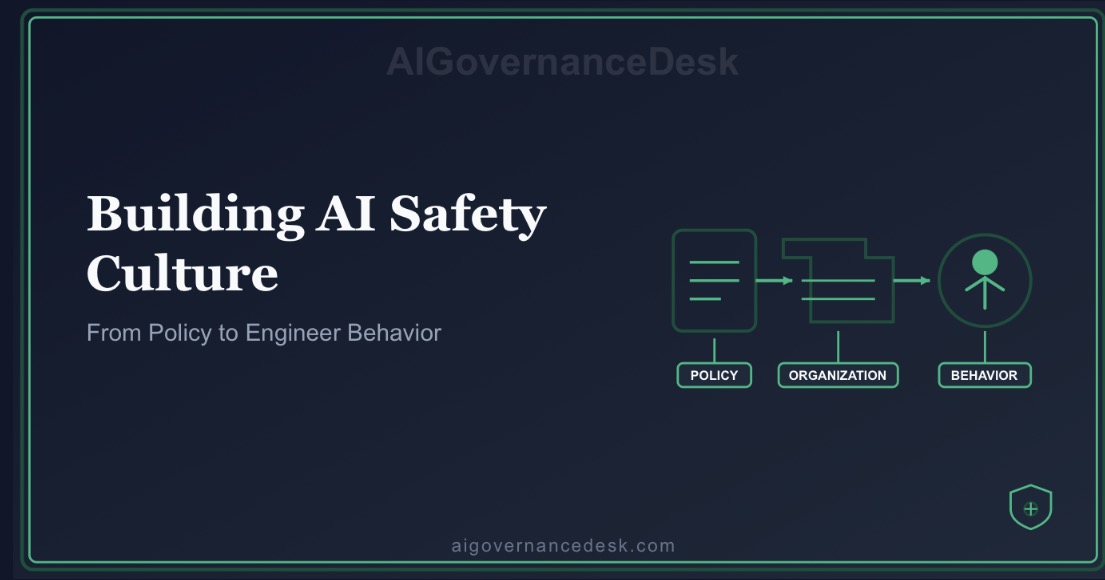
Organizations deploying high-risk AI systems increasingly possess the expected documentation: model cards, risk registers, bias assessments, and governance policies signed by executives. Yet safety incidents continue to trace back to human decision points—engineers who override red flags to meet release deadlines, teams that skip impact assessments under sprint pressure, or deployers who assign oversight to staff without the competence or authority to intervene. The gap is not in documentation. It is in behavioral infrastructure: the organizational mechanisms that cause individuals to act on policy when production pressure pushes in the opposite direction.
The International AI Safety Report 2026 identifies this as a structural governance challenge. Published in February 2026 by a consortium of 30 nations, 100 AI experts, and the UN, the report notes that pre-deployment evaluations remain unreliable predictors of real-world AI behavior, and that organizational risk management practices are still at an early stage. The residual risk—what testing cannot catch—falls into the space occupied by culture, training, and human judgment. When that space is hollow, the system fails at the boundary between what was documented and what was done.
Why Documentation Audits Miss the Real Risk
Current compliance verification focuses overwhelmingly on artifacts. Auditors check whether a policy exists, whether a model card was completed, whether a risk register was updated. These are necessary conditions, but they are not sufficient. A policy signed by an executive who cannot explain how it operates in practice is a compliance fiction. A risk register that sits in a shared drive while engineers deploy without reviewing it is a liability exposure, not a control.
The behavioral audit gap is the unmeasured space between policy existence and policy adherence. Regulators and certification bodies are beginning to recognize this. The ISO/IEC 42001:2023 standard for AI management systems (AIMS) requires not only documented policies but evidence of leadership commitment, resource allocation, and management review. The NIST AI Risk Management Framework treats its GOVERN function as cross-cutting, explicitly intended to drive organizational culture change rather than provide a compliance checklist. And the EU AI Act binds providers and deployers to obligations for high-risk systems that cannot be satisfied on paper alone — obligations now set to take effect December 2, 2027 for standalone high-risk systems (Annex III) and August 2, 2028 for high-risk systems embedded in regulated products (Annex I), following the Digital Omnibus agreement that entered into force in July 2026 and postponed the original August 2, 2026 deadline.
What connects these frameworks is a shared, if implicit, mandate: safety culture is not an HR initiative. It is a regulatory and standards-enforceable condition of lawful AI deployment.
The Regulatory and Standards Convergence on Safety Culture
NIST AI RMF: GOVERN as Cultural Infrastructure
The NIST AI RMF is voluntary guidance, but its influence on regulatory expectations, procurement requirements, and standards development makes it a de facto governance baseline. The framework’s GOVERN function is designed to permeate every other function—MAP, MEASURE, and MANAGE—by establishing the organizational conditions under which risk management actually occurs.
Specific GOVERN subcategories create behavioral expectations that extend well beyond document creation. GV-1.1 requires legal and regulatory requirements to be understood and integrated into organizational risk management. GV-1.2 demands that accountability structures are established, documented, and communicated. GV-2.1 mandates that organizational team roles and responsibilities for AI risk management are defined. GV-4.1 requires organizational risk tolerance to be established and communicated. GV-5.1 mandates risk communication to relevant AI actors. GV-6.1 addresses workforce diversity and inclusion as a risk management input. GV-7.1 requires engagement with AI actors outside the organization. GV-8.1 governs third-party risk management.
The NIST AI RMF Playbook operationalizes these subcategories with specific actions, many of which are behavioral rather than documentary: conducting regular workforce training, establishing feedback mechanisms for AI actors, and ensuring that risk tolerance is not merely published but understood by those making deployment decisions. The framework’s emphasis on culture is structural, not decorative. GOVERN is positioned as the function that determines whether the other three functions produce genuine risk reduction or performative compliance.
ISO/IEC 42001: Leadership as an Auditable Requirement
Where NIST provides guidance, ISO/IEC 42001:2023 provides a certifiable standard. Its requirements are auditable, and auditors expect evidence that goes beyond policy documents. Clause 5.1 requires top management to demonstrate leadership and commitment by ensuring the AI policy aligns with strategic direction, integrating the AIMS into business processes, making resources available, and promoting continual improvement. Clause 5.2 requires a documented AI policy. Clause 5.3 requires assigned roles, responsibilities, and authorities—what the standard frames as named accountability rather than assumed responsibility.
Clause 6.1.4 introduces the AI system impact assessment, a requirement that forces outward-looking consequence analysis. This is not a technical exercise; it is a behavioral one. The assessment must consider the context of use, the stakeholders affected, and the potential for adverse impacts. It requires engineers and product teams to step outside technical specifications and evaluate how the system will function in the world. When integrated into development workflows, this clause shapes priorities. When treated as a post-hoc documentation task, it becomes another checkbox.
The standard’s structure makes clear that AIMS is not an IT project. It is a management system that must be embedded into the organization’s broader governance architecture. Auditors will look for management review minutes, evidence of resource allocation, and proof that executive leadership understands how the AIMS operates—not merely that they approved it.
The EU AI Act: Binding Behavioral Obligations
The EU AI Act creates legally enforceable conditions that directly implicate organizational culture and individual behavior. For high-risk AI systems, Article 9 requires a risk management system that is continuous, iterative, and run throughout the entire lifecycle, with regular systematic review and updating. This is not a one-time assessment. It is an ongoing operational discipline that must be staffed, resourced, and executed under real-world conditions.
Article 14 mandates that high-risk systems be designed for effective human oversight, including capabilities to understand system limitations, detect anomalies, avoid automation bias, interpret output, override decisions, and intervene via a stop mechanism. Article 26(2) requires deployers to assign human oversight to natural persons who have the necessary competence, training, and authority, as well as the necessary support. The obligation is behavioral: the deployer must ensure that the person exercising oversight is capable of doing so, not merely that a person is nominally present.
Article 17(1)(m) requires providers to establish a quality management system that includes an accountability framework setting out the responsibilities of management and other staff. Article 72 requires post-market monitoring. Article 73 mandates serious incident reporting within 15 days, or 2 days for critical infrastructure. These obligations create a closed loop: design for oversight, assign competent people, monitor performance, report failures, and update the system. The loop breaks when any behavioral link—training, authority, escalation, reporting—fails.
Penalties for high-risk violations reach €15 million or 3% of global annual turnover. The financial exposure is real, but the compliance exposure is deeper. An organization that can produce a policy but cannot demonstrate that its engineers acted on it faces a gap that documentation cannot close.
Organizational Mechanisms That Translate Policy into Behavior
Decision Rights and Escalation Pathways
The EU AI Act Article 17(1)(m) requires providers to establish an accountability framework setting out the responsibilities of management and other staff. ISO/IEC 42001:2023 Clause 5.3 similarly demands that roles, responsibilities, and authorities be assigned and communicated. These requirements converge on a single operational reality: someone specific must own the decision to deploy, modify, or halt a high-risk AI system.
Diffuse committee structures create accountability gaps. When a safety concern arises during a sprint, an engineer needs a named individual with the authority to pause release—not a governance board that meets monthly. The NIST AI RMF GOVERN function emphasizes this through GV-1.2 (accountability structures) and GV-2.1 (organizational team roles). Effective organizations document not only who decides but the escalation pathway when a team member identifies a risk that exceeds their authority. This pathway must be tested, not merely published. An escalation chain that has never been exercised is a procedural fiction.
Resource Allocation as Cultural Signaling
ISO/IEC 42001:2023 Clause 5.1 requires top management to ensure that resources for the AIMS are available. This is not boilerplate. Budget, headcount, and tooling allocations are the most honest signals of organizational priority. A safety policy backed by a skeleton team and outdated tooling communicates that compliance is performative. Conversely, when risk assessment tooling, red-teaming infrastructure, and post-deployment monitoring systems receive sustained capital allocation, engineers receive a clear signal that protective behavior is operationally supported.
The NIST AI RMF Playbook reinforces this by linking GOVERN actions to resource planning. Organizations that treat AI risk management as a cost center staffed by junior analysts create a structural mismatch: high-stakes decisions are made by people with insufficient time, tools, or seniority to challenge product timelines. Regulators and auditors can detect this mismatch through payroll records, procurement documentation, and training budgets. Resource allocation is auditable evidence of cultural commitment.
Cross-Functional Governance Bodies
Both the NIST framework and ISO 42001 expect AI risk management to be integrated into business processes, not isolated in a technical ethics board. The EU AI Act’s quality management system requirement under Article 17 spans design, development, quality control, post-market monitoring, and incident reporting. This breadth demands participation from legal, risk, compliance, data science, engineering, and product functions.
Cross-functional integration fails when one function dominates. Product teams that view safety review as a blocking gate rather than a design input will route around it. Legal teams that draft policies without engineering input produce documents that do not describe actual workflows. Effective governance bodies include decision rights for each function, clear criteria for when consensus is required versus when a single function has override authority, and documented minutes that demonstrate active deliberation rather than passive review.
Engineering Team-Level Behavioral Integration
Safety Gates in Development Workflows
Behavioral compliance becomes durable when the protective path requires less effort than the risky path. Engineering teams can achieve this by embedding safety checks into continuous integration and deployment pipelines. Model cards, datasheets, and AI system impact assessments become blocking gates: a pull request cannot merge without completion, and a deployment cannot proceed without sign-off from the named accountable individual.
Pre-mortems, stop conditions, and exposure caps should be routine steps before experimentation, not exceptional procedures. The ISO/IEC 42001:2023 impact assessment under Clause 6.1.4 is designed to be conducted during development, not after. When integrated into ticketing systems and sprint rituals, these assessments shape technical choices. When treated as documentation tasks for audit season, they produce generic text that does not influence design.
Incident Response and Post-Mortem Protocols
The EU AI Act Article 73 requires providers to report serious incidents to market surveillance authorities without delay and no later than 15 days after becoming aware. This creates a hard timeline that must be supported by internal detection and escalation procedures. Organizations need predefined severity matrices, root cause analysis protocols, and communication chains that integrate with existing cybersecurity incident response capabilities.
Post-mortem culture determines whether incident reporting remains a compliance exercise or becomes a genuine learning mechanism. When post-mortems focus on individual blame, engineers learn to delay reporting, minimize severity, or route incidents through informal channels. When they focus on system fixes—policy gaps, tooling failures, or workflow blind spots—reporting volume increases, and the organization gains a leading indicator of cultural health. High reporting rates coupled with rapid remediation cycles signal a functional safety culture. Low reporting rates in complex systems often signal suppression, not safety.
Psychological Safety and Speak-Up Mechanisms
The International AI Safety Report 2026 identifies information asymmetry as a core governance challenge: developers and engineers often possess critical safety information that does not reach decision-makers. This asymmetry is not a technical problem. It is an organizational behavior problem. When raising a safety concern requires navigating a chain of command that includes the project’s sponsor, or when past whistleblowers experienced career consequences, engineers rationally choose silence.
Effective safety cultures build anonymous reporting channels, explicit non-retaliation policies, and safety drills that normalize raising concerns. As AI governance matures, these mechanisms are shifting from voluntary best practice to assessed governance criteria. The EU AI Act’s accountability framework under Article 17(1)(m) and the ISO 42001 requirement for continual improvement under Clause 10.1 create implicit pressure for organizations to demonstrate that safety concerns can surface and be addressed. Speak-up mechanisms are no longer HR programs—they are compliance infrastructure.
The Human Oversight Behavior Gap
Article 14 of the EU AI Act mandates that high-risk systems be designed with technical capabilities for human oversight: interpretability features, override functions, and stop mechanisms. Article 26(2) imposes a separate, behavioral obligation on deployers: they must assign oversight to natural persons with the necessary competence, training, authority, and support. The split between provider design and deployer behavior creates a common implementation failure.
Organizations frequently satisfy Article 14 through technical design without ensuring that Article 26(2) is operationalized in deployment. A dashboard with an override button does not constitute meaningful oversight if the assigned operator lacks training on when to use it, lacks authority to act against automated recommendations, or lacks support from management when their intervention delays a process. Published regulatory guidance indicates that the standard for meaningful human oversight remains underdeveloped, creating implementation ambiguity that deployers must resolve through internal competence frameworks rather than wait for further specification.
Automation bias compounds the gap. Research on human-AI interaction indicates that operators defer to algorithmic recommendations even when they have override capability. Effective oversight design must actively counter this tendency through training that includes adversarial scenarios, interface design that highlights uncertainty, and organizational norms that treat override as an expected behavior rather than an exceptional event. Without these behavioral supports, Article 14’s technical requirements and Article 26(2)’s personnel requirements operate in parallel without converging into actual protection.
Measuring Culture and Behavioral Compliance
From Documentation to Behavioral Verification
Current audit practice verifies policy existence, model card completion, and risk register maintenance. These are lagging indicators of governance intent. They confirm that someone produced a document, not that the organization acts on it. The shift from documentation audit to behavioral verification requires metrics that capture what happens under operational pressure.
ISO/IEC 42001:2023 Clause 9 addresses performance evaluation, requiring the organization to evaluate AI performance and the AIMS itself. The NIST AI RMF MEASURE function similarly emphasizes ongoing assessment of AI risks and impacts. Both frameworks provide structural support for behavioral metrics, but most organizations underutilize them for cultural assessment. The result is a verification system that confirms documentation hygiene while remaining blind to the behavioral conditions that determine whether a safety policy survives contact with production deadlines.
Indicators That Reveal Culture
Specific behavioral indicators can be embedded into existing workflows and reviewed during management review cycles:
- Override rates: the frequency with which human operators exercise their Article 14 override authority, tracked by system and by operator. Persistently low rates may indicate automation bias, insufficient training, or interface design that obscures the override function.
- Post-mortem participation: the percentage of incidents that trigger a documented post-mortem within the organization’s defined timeline, and the elapsed time from detection to completion. High participation with short completion cycles signals a learning culture. Low participation signals suppression or avoidance.
- Safety suggestion volume: the number of safety concerns raised through formal channels per development cycle, normalized by team size. Declining volume in complex systems often indicates that raising concerns has become professionally costly, not that the system has become safer.
- Mean time to escalation: the interval between a team member identifying a risk and that risk reaching an individual with decision authority. Extended intervals reveal blockage in the escalation pathway, even when the pathway is documented.
- Training completion quality: not merely completion rates, but assessment scores on adversarial scenarios, override decision simulations, and anomaly recognition under time pressure.
These metrics are leading indicators. They reveal cultural health before an incident occurs. Lagging indicators—incident counts, regulatory findings, and penalty amounts—confirm failure after the fact. Governance teams should build dashboards that weight leading indicators more heavily, embedding them within the quality management system procedures required by Article 17. When behavioral metrics appear in management review minutes alongside budget and headcount data, safety culture becomes auditable.
Common Implementation Failures
Organizations repeatedly make specific errors that create concurrent regulatory, reputational, and operational exposures.
Treating AIMS as an IT project rather than a business system integration violates ISO/IEC 42001:2023 Clause 5.1, which requires integration into business processes. When the AIMS sits within a data science team without legal, risk, or product involvement, it produces technical documentation that does not address business-level impacts. Auditors identify this failure mode through organizational chart review and interview evidence. The system appears complete on paper while remaining disconnected from the decisions that actually determine risk exposure.
Executive policy signatures without operational understanding represent a recurring finding. A policy signed by an executive who cannot explain how it is implemented, or who is unaware of the resource requirements for compliance, is a liability. The EU AI Act Article 17 accountability framework and ISO 42001 Clause 5.1 both require active leadership engagement, not passive approval. Management review minutes that show no discussion of resource constraints, incident trends, or training gaps reveal a ceremonial rather than functional governance process.
Human oversight is frequently assigned without verifying competence, authority, or support. Article 26(2) requires deployers to ensure that oversight personnel have all three. In practice, organizations often designate the nearest available employee, provide a brief tutorial, and assume the technical design under Article 14 will handle the rest. This creates a compliance gap that documentation cannot obscure: the deployer can produce an org chart showing a named individual, but cannot demonstrate that the individual was capable of effective intervention when the system produced an anomalous output under operational pressure.
Cross-Framework Cultural Convergence
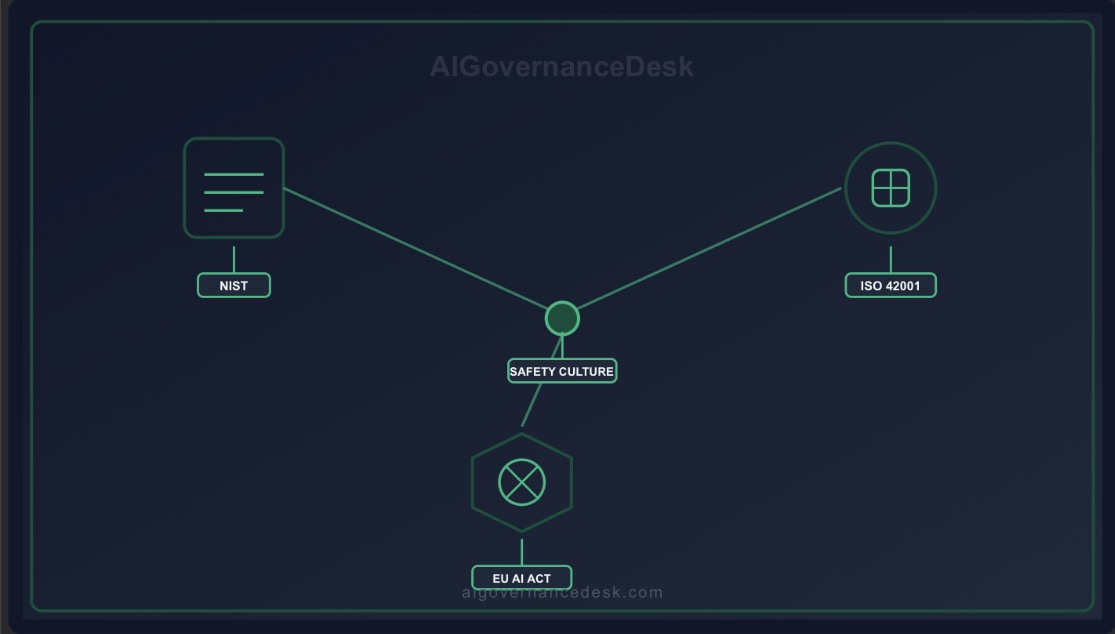
Most publications analyze the NIST AI RMF, ISO/IEC 42001, and the EU AI Act as separate compliance silos. This approach misses a structural convergence: all three frameworks impose similar behavioral conditions on organizations, despite differing legal status.
NIST GOVERN subcategories GV-1.2, GV-2.1, and GV-4.1 require named accountability, defined roles, and communicated risk tolerance. ISO 42001 Clauses 5.1, 5.2, and 5.3 require leadership commitment, a documented policy, and assigned responsibilities. The EU AI Act Articles 9, 14, 17, and 26 require iterative risk management, human oversight design, an accountability framework, and competent oversight personnel. The convergence is not coincidental. It reflects a shared recognition that AI risk management fails when it remains at the policy level.
Specifically, all three frameworks require explicit assignment of responsibility rather than assumed accountability, resource commitment rather than policy endorsement alone, workforce competence rather than just technical system capability, and continuous operational discipline rather than point-in-time assessment. This convergence transforms safety culture from an aspirational goal into a compliance intersection. An organization that meets the EU AI Act’s binding obligations, certifies to ISO 42001, and implements NIST GOVERN actions will have, as a byproduct, a demonstrable safety culture. An organization that treats any one framework as a documentation exercise will likely fail the behavioral requirements of all three.
The Behavioral Audit Gap
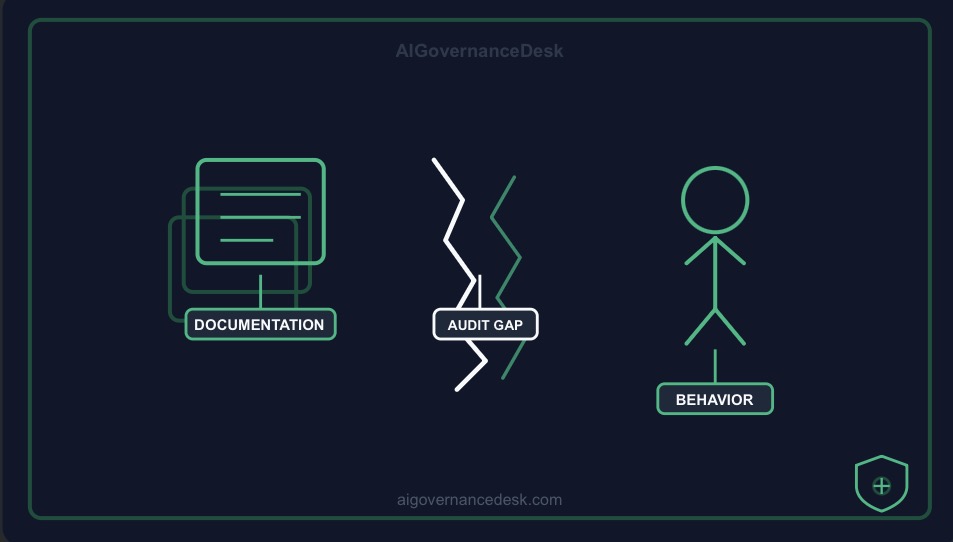
Current compliance verification is structurally limited. Auditors examine policies, risk registers, model cards, and training records. They confirm that documents exist, that signatures are present, and that dates fall within required intervals. What they rarely examine is whether an engineer, facing a production deadline and an ambiguous model output, escalated the concern through the documented channel. Whether a human operator, confronted with an anomalous system recommendation, exercised their override authority. Whether a post-mortem, triggered by a near-miss, identified a policy gap rather than attributing blame to an individual. These are behavioral events, and they are largely invisible to document-centric audit protocols.
The gap is widening. The EU AI Act Articles 14 and 26, ISO/IEC 42001:2023 Clauses 5.1 and 5.3, and the NIST AI RMF GOVERN function all impose conditions that can only be verified through observation of behavior, not review of artifacts. An accountability framework on paper satisfies Article 17(1)(m) only if the named individuals actually exercise their authority when safety and speed conflict. A training record satisfies Article 26(2) only if the trained operator can demonstrate competent intervention under operational conditions. Documentation audits cannot capture these moments.
Behavioral verification requires different methods. Sampling escalation records to confirm they reached a decision-maker within the defined timeframe. Reviewing override logs to identify patterns of non-use that suggest automation bias. Interviewing operators about their last intervention, not merely confirming they attended training. Examining post-mortem records for the ratio of system fixes to individual attributions. These methods are more intrusive than document review, but they are necessary if verification is to assess culture rather than paperwork.
Engineering Practice Integration
Governance requirements achieve behavioral force only when they become engineering rituals. The International AI Safety Report 2026 notes that organizational risk management practices remain at an early stage. One structural cause is the persistent separation between governance teams, who write requirements, and engineering teams, who build systems. When governance delivers a policy document and expects engineering to operationalize it, the policy as understood by compliance frequently differs from the policy as implemented in code.
Closing this separation requires embedding governance requirements into the development lifecycle at the point where technical decisions are made. ISO/IEC 42001:2023 impact assessments under Clause 6.1.4 must be completed before architecture decisions harden, not after. Stop conditions for experimentation must be defined when the experiment is designed, not when results are reviewed. Override testing must be part of the quality assurance protocol, with test cases that verify the operator receives sufficient context for a decision under operational load. When these requirements are integrated into the same rituals that govern technical correctness—sprint planning, code review, deployment approval—they shape design choices. When they are treated as external compliance tasks, they produce documentation that describes a system the engineering team did not actually build.
The timing of governance involvement determines its influence. Legal and risk functions that participate in sprint planning for high-risk features contribute to scope and architecture before development begins. Safety requirements added after the architecture is fixed are expensive to implement and frequently deferred. The EU AI Act Article 9 requires risk management throughout the entire lifecycle. This implies governance presence at design, not merely at deployment review. Organizations that treat governance as a final checkpoint before release are not conducting lifecycle risk management. They are conducting pre-release documentation validation.
What Compliance Teams Must Change
Compliance teams accustomed to document-centric verification must expand their protocols to include behavioral sampling. This does not require abandoning document review. It requires adding behavioral layers: reviewing override logs alongside training records, sampling escalation outcomes alongside policy text, and interviewing oversight personnel about their last intervention alongside checking their job description for authority.
Behavioral metrics should be integrated into management review cycles under ISO/IEC 42001:2023 Clause 9.3. When executive leadership reviews AIMS performance, the agenda should include leading indicators—safety suggestion volume, mean time to escalation, override rates—not merely lagging indicators like incident counts and audit findings. This shifts management attention from past failures to current cultural health.
Cross-functional review must move from periodic meetings to development milestones. Safety review should be a gate in the development lifecycle, not a checkpoint at the end. The EU AI Act Article 17 quality management system and NIST AI RMF GOVERN actions both expect integration into business processes. Compliance teams should verify this integration by examining whether safety criteria appear in project management workflows, whether risk assessments are referenced in architecture decision records, and whether post-market monitoring data feeds back into development prioritization. These are behavioral traces. They reveal whether governance is operational or ornamental.
The regulatory trajectory indicates that behavior will become an increasingly explicit audit target. Binding obligations under the EU AI Act, certifiable requirements under ISO/IEC 42001:2023, and cultural mandates under the NIST AI RMF are converging on what people do, not merely what they document. Organizations that build verification systems capable of measuring behavior will be prepared for the next phase of regulatory scrutiny. Those that remain in the documentation-only paradigm will discover that their compliance posture collapses at the first behavioral test.
Compliance Priorities for Closing the Policy-to-Behavior Divide
Immediate Accountability Actions
Governance teams should begin by verifying that the accountability framework required by EU AI Act Article 17(1)(m) names specific individuals with decision authority, not departments or committees. Each named individual should be able to articulate their scope of authority, the escalation pathway when they are unavailable, and the criteria that trigger a deployment halt. ISO/IEC 42001:2023 Clause 5.3 requires these roles to be assigned and communicated. Verification should include interviews, not merely org charts. An individual who appears on the accountability framework but cannot describe their decision criteria is evidence of a documentation gap, not a control.
Resource allocation should be reviewed against the requirements of ISO 42001 Clause 5.1 and the NIST AI RMF GOVERN function. Compliance teams should examine whether the AIMS has a dedicated budget line, whether safety tooling receives regular capital refresh, and whether headcount for risk assessment and post-market monitoring is sufficient relative to the number of high-risk systems in production. Resource constraints that force safety review into overtime or deferred sprints create a behavioral gap that no policy can close.
Behavioral Measurement Implementation
Within the next quarter, governance teams should select three to five leading behavioral indicators and embed them into existing reporting cycles. Override rates, post-mortem completion intervals, safety suggestion volume, and mean time to escalation are measurable from existing systems with minimal tooling investment. These metrics should appear in management review agendas under ISO/IEC 42001:2023 Clause 9.3, alongside traditional lagging indicators. The first review cycle should establish baseline values; subsequent cycles should track trends. A declining safety suggestion volume in a system of stable or increasing complexity is a red flag that warrants investigation, not celebration.
Training programs should shift from completion verification to competence demonstration. Article 26(2) requires competence, not attendance. Assessments should include scenario-based testing: operators must demonstrate that they can recognize an anomalous output, interpret system limitations, and exercise override authority under time pressure. Training records that show 100% completion but assessment scores that reveal poor scenario performance indicate a compliance gap that documentation masks.
Workflow Integration
Safety gates must become blocking conditions in the development lifecycle. Impact assessments under ISO/IEC 42001:2023 Clause 6.1.4 should be required before architecture decisions are approved, not after code is written. Pre-mortems and stop conditions should be standard entries in sprint planning templates. Post-market monitoring data under Article 72 should feed directly into product backlog prioritization. When safety requirements are embedded into the same rituals that govern technical delivery, they influence design. When they remain external compliance tasks, they produce documentation that describes a system the engineering team never actually built.
Next Regulatory Milestones
Organizations should prepare for the intensification of post-market monitoring obligations. Article 72 requires providers to establish a system for collecting and reviewing performance data throughout the system lifecycle. This obligation will generate behavioral evidence: whether monitoring data is reviewed on schedule, whether anomalies trigger escalation, and whether findings result in system updates. Market surveillance authorities will examine not only whether the monitoring system exists but whether it produced documented action.
Surveillance audits under ISO/IEC 42001:2023 will increasingly probe behavioral evidence. Certification bodies are expected to move beyond policy review toward sampling of management review minutes, escalation records, and post-mortem outcomes. Organizations that have built behavioral metrics into their AIMS will be prepared. Those that have relied on documentation alone will face nonconformities that require costly remediation.
The International AI Safety Report 2026 identified organizational risk management as an early-stage discipline. As regulatory frameworks mature and enforcement actions accumulate, the gap between policy and behavior will become a primary liability exposure. Governance teams that act now to build measurable behavioral infrastructure will have converted safety culture from an aspiration into an auditable, defensible operational reality.

Covering responsible AI, governance frameworks, policy, ethics, and global regulations shaping the future of artificial intelligence.