As the EU AI Act moves from policy framework to active enforcement, the way organizations govern artificial intelligence is undergoing a fundamental shift. By August 2026, high-risk AI system obligations become broadly applicable, transparency rules for synthetic content take effect, and national regulatory sandboxes are required to be operational. In parallel, guidance from the European AI Office and early enforcement signals from data protection and market authorities are making one thing clear: informal, manual approaches to AI compliance will not scale.
For many organizations, AI governance has historically relied on spreadsheets, internal wikis, and fragmented documentation owned by different teams. That approach might have been sufficient when AI deployments were limited in scope and regulatory scrutiny was still emerging. In 2026, however, AI systems are more complex, more distributed, and more deeply embedded in core business processes. Compliance teams are now expected to demonstrate traceability, robustness, and accountability across entire AI lifecycles — often on short notice and under regulatory pressure.
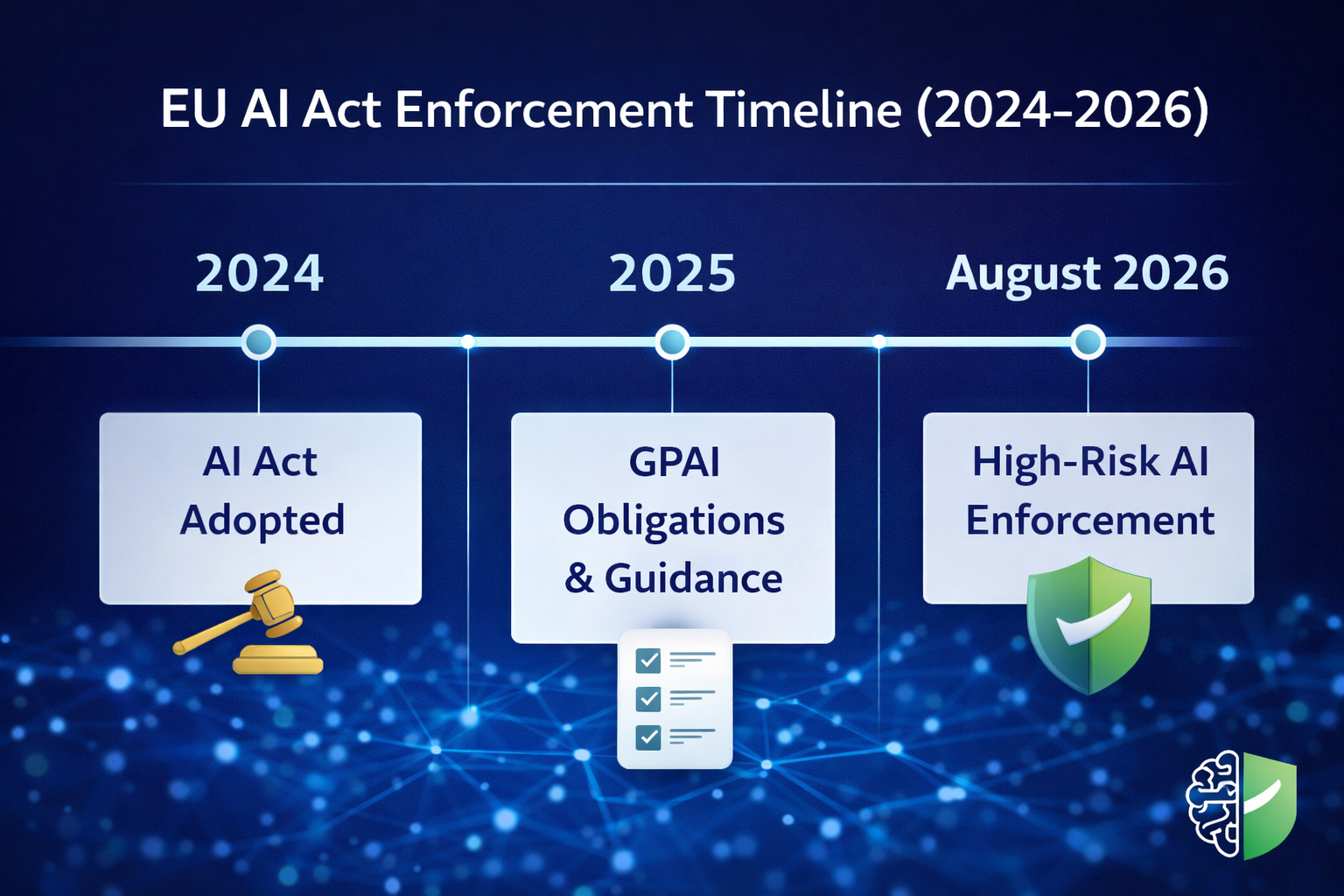
This is where AI governance software becomes mission-critical. Specialized platforms are no longer a “nice to have” or an enterprise luxury. They are rapidly becoming the backbone that enables organizations to meet EU AI Act obligations without overwhelming engineering, legal, and compliance teams with manual overhead. The right tools allow organizations to shift from reactive compliance to proactive governance — identifying risks early, producing audit-ready evidence, and supporting responsible AI deployment at scale.
The challenge, however, is not simply buying software. The AI governance tooling landscape has expanded quickly, and many platforms overlap in features while differing significantly in focus, maturity, and regulatory alignment. There is no single “best” AI governance platform for every organization. Instead, the most effective governance stacks are built by selecting tools that address distinct, foundational needs across the AI lifecycle.
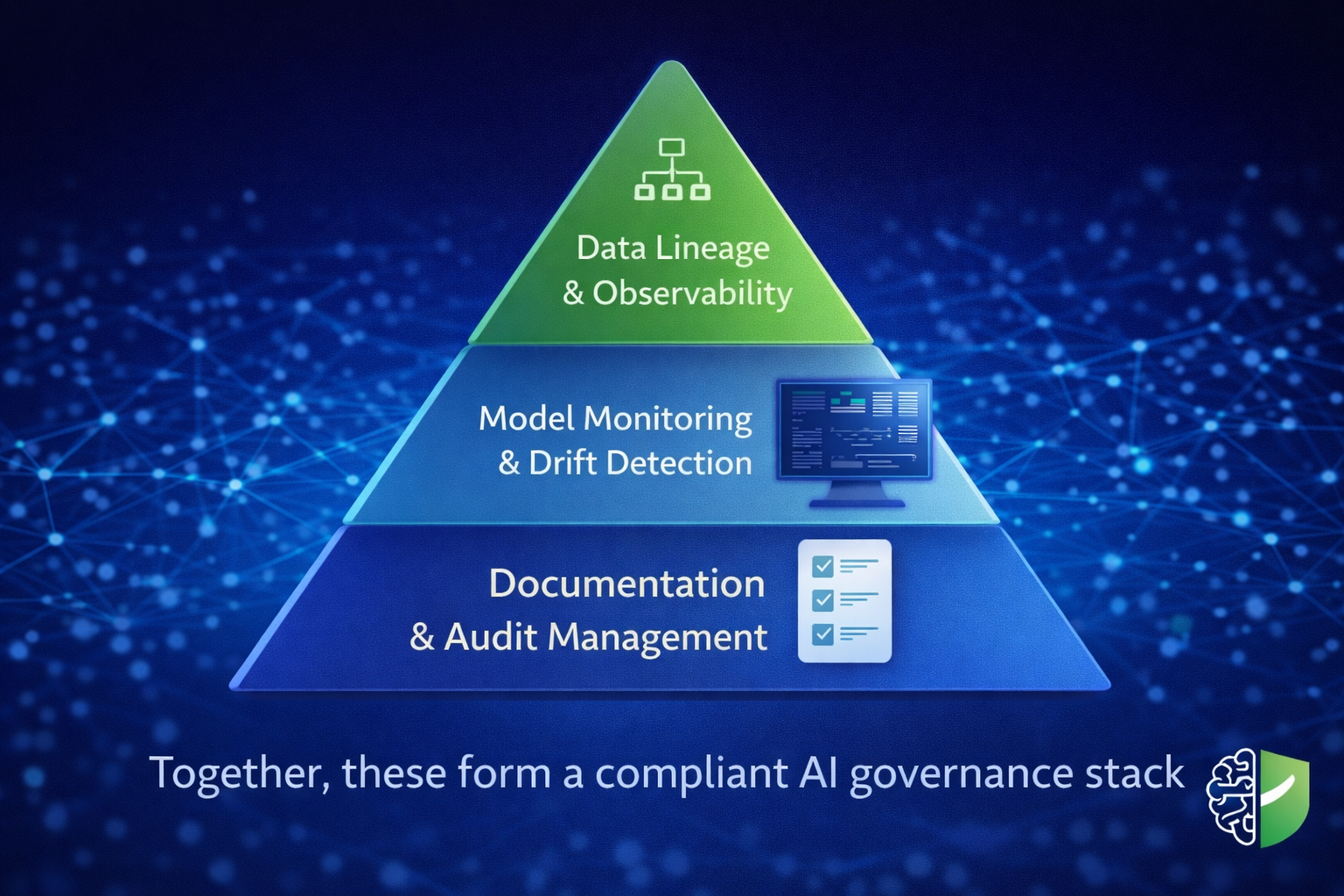
In this guide, we focus on three core categories of AI governance software that every serious compliance team should evaluate in 2026, alongside an emerging layer focused on decision-level traceability:
- Data lineage and observability platforms, which provide end-to-end traceability across datasets, transformations, and model inputs
- Model monitoring and drift detection tools, which support ongoing robustness, fairness, and post-deployment oversight
- Documentation and audit management systems, which consolidate technical files, conformity evidence, and regulator-facing artifacts
These categories map directly to core EU AI Act requirements, including data governance under Article 10, robustness and post-market monitoring obligations under Articles 15 and 72, and the extensive documentation requirements outlined in Annex IV. Together, they form an evergreen governance foundation that remains relevant even as regulatory frameworks evolve beyond Europe.
Throughout this article, we take a neutral, expert-driven approach. Rather than promoting a single vendor, we examine leading platforms in each category, highlight their strengths and limitations, and explain where they fit best depending on organizational scale, risk profile, and existing technology stacks. Where appropriate, we connect these tools to practical governance concepts explored in resources such as What Is AI Governance? A Complete Guide to Responsible AI Oversight and The Engineer’s Practical Guide to EU AI Act Compliance.
By the end of this guide, compliance leaders, legal teams, and AI practitioners should have a clear framework for evaluating AI governance software in 2026 — and for building a tool stack that turns regulatory compliance from a cost center into a strategic advantage.
The Need for Specialized AI Governance Software in 2026
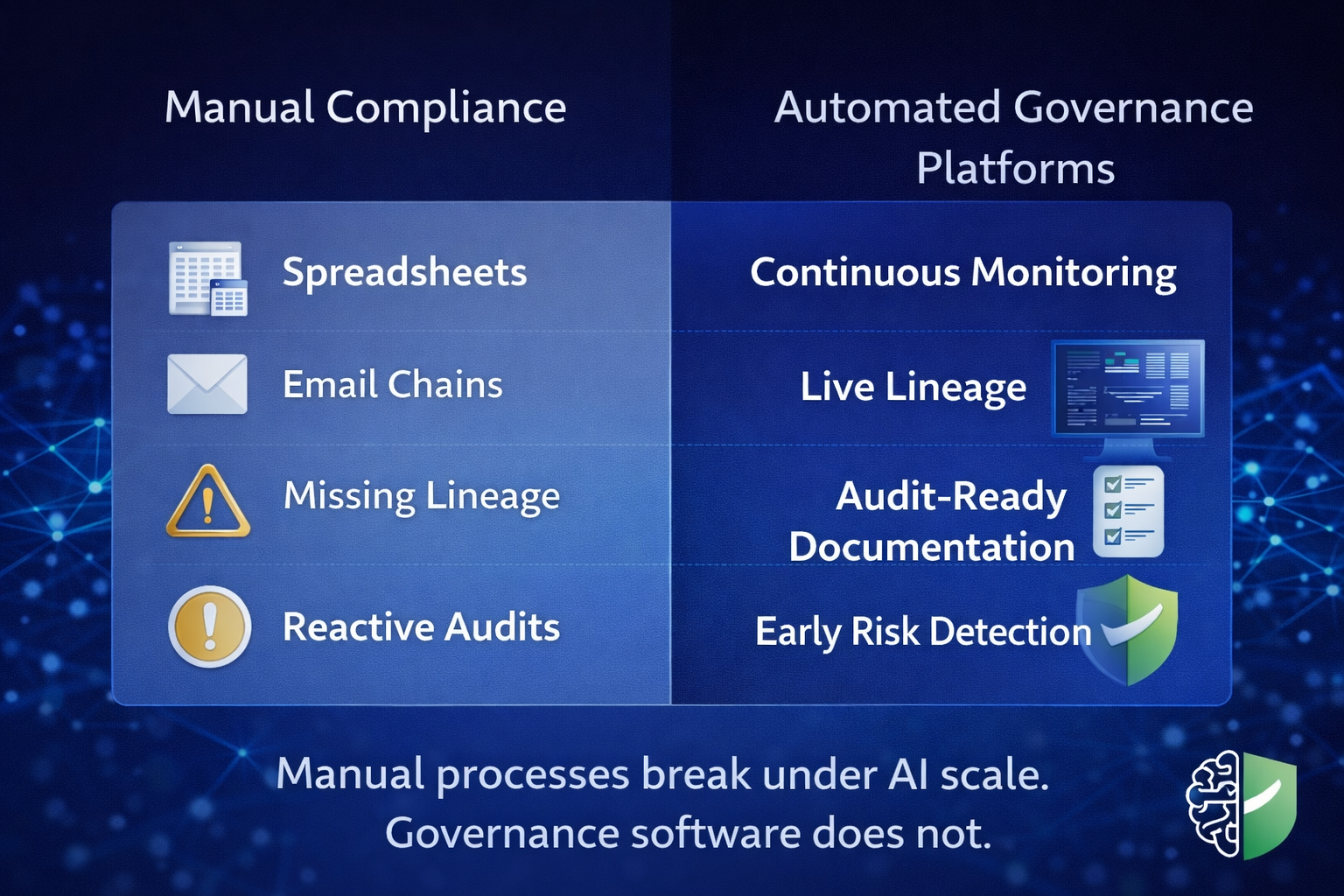
By 2026, AI compliance has become a systems problem rather than a documentation exercise. The EU AI Act introduces obligations that extend far beyond policy statements or internal checklists. High-risk AI systems must be supported by demonstrable controls across data governance, model robustness, human oversight, and post-deployment monitoring. For organizations operating complex AI pipelines, meeting these expectations manually is no longer realistic.
One of the most significant shifts introduced by the EU AI Act is the emphasis on traceability. Regulators are not only interested in whether appropriate safeguards exist, but whether organizations can prove — with evidence — how data was sourced, transformed, validated, and used in model training and deployment. Article 10 explicitly requires documented data governance practices, including dataset provenance, relevance, representativeness, and bias mitigation. Attempting to reconstruct this information retroactively using spreadsheets or disconnected tools is both error-prone and risky.
Equally important is the Act’s focus on robustness and post-market monitoring. Articles 15 and 72 establish expectations for continuous oversight of AI systems once they are deployed. This includes detecting performance degradation, concept drift, unexpected bias, and emerging risks over time. In practice, this means organizations must move beyond one-time model validation and adopt continuous monitoring processes that generate auditable logs and alerts. Manual spot checks or ad hoc reviews cannot satisfy these requirements at scale.
Documentation is the third pressure point. Annex IV of the EU AI Act outlines extensive technical documentation requirements, including system descriptions, design specifications, risk management measures, testing procedures, and human oversight mechanisms. For many organizations, this documentation already exists — but scattered across engineering repositories, compliance folders, and individual team knowledge. Without centralized documentation and version control, responding to regulatory inquiries becomes slow, inconsistent, and costly.
Specialized AI governance software addresses these challenges by automating evidence collection and aligning technical workflows with regulatory expectations. Rather than treating compliance as a downstream reporting task, governance platforms integrate directly into data pipelines, model development processes, and operational monitoring systems. This integration reduces the burden on teams while increasing the reliability and defensibility of compliance artifacts.
The risks of not adopting such tools are no longer theoretical. Recent enforcement actions and high-profile investigations demonstrate how quickly compliance gaps can escalate into financial penalties, litigation, and reputational damage. As detailed in The Real Cost of AI Non-Compliance: Fines, Lawsuits, and Reputational Damage Case Studies, many organizations underestimated the cumulative impact of weak governance controls — particularly when regulators requested evidence that could not be produced in a timely or coherent manner.
At the same time, organizations face growing internal pressure. Shadow AI usage, decentralized model development, and the rapid adoption of foundation models make it difficult for compliance teams to maintain visibility. Governance software helps surface these hidden risks by providing centralized oversight, standardized workflows, and shared accountability across teams.
The table below illustrates how core EU AI Act requirements map directly to software-enabled capabilities — highlighting why tooling is becoming indispensable rather than optional.
| EU AI Act Requirement | Regulatory Focus | Software Capability Needed |
|---|---|---|
| Article 10 – Data Governance | Training data quality, provenance, bias mitigation | Automated data lineage, dataset metadata, provenance tracking |
| Article 15 – Robustness & Accuracy | Performance stability, resilience to misuse | Model monitoring, drift detection, robustness testing logs |
| Article 72 – Post-Market Monitoring | Ongoing risk detection after deployment | Continuous monitoring dashboards, alerting, incident tracking |
| Annex IV – Technical Documentation | Audit-ready system and risk documentation | Centralized documentation, version control, exportable reports |
Taken together, these requirements explain why governance maturity in 2026 is increasingly measured by tooling, not intent. Organizations that invest early in the right AI governance software gain operational efficiency, reduce enforcement risk, and improve trust with regulators and stakeholders alike. Those that delay often find themselves scrambling to retrofit controls after deployment — a pattern that consistently proves more expensive and disruptive.
In the next sections, we examine three categories of governance platforms in detail, starting with the foundational layer: data lineage and observability tools that enable traceability across high-risk AI systems.
Tool 1: Data Lineage and Observability Platforms
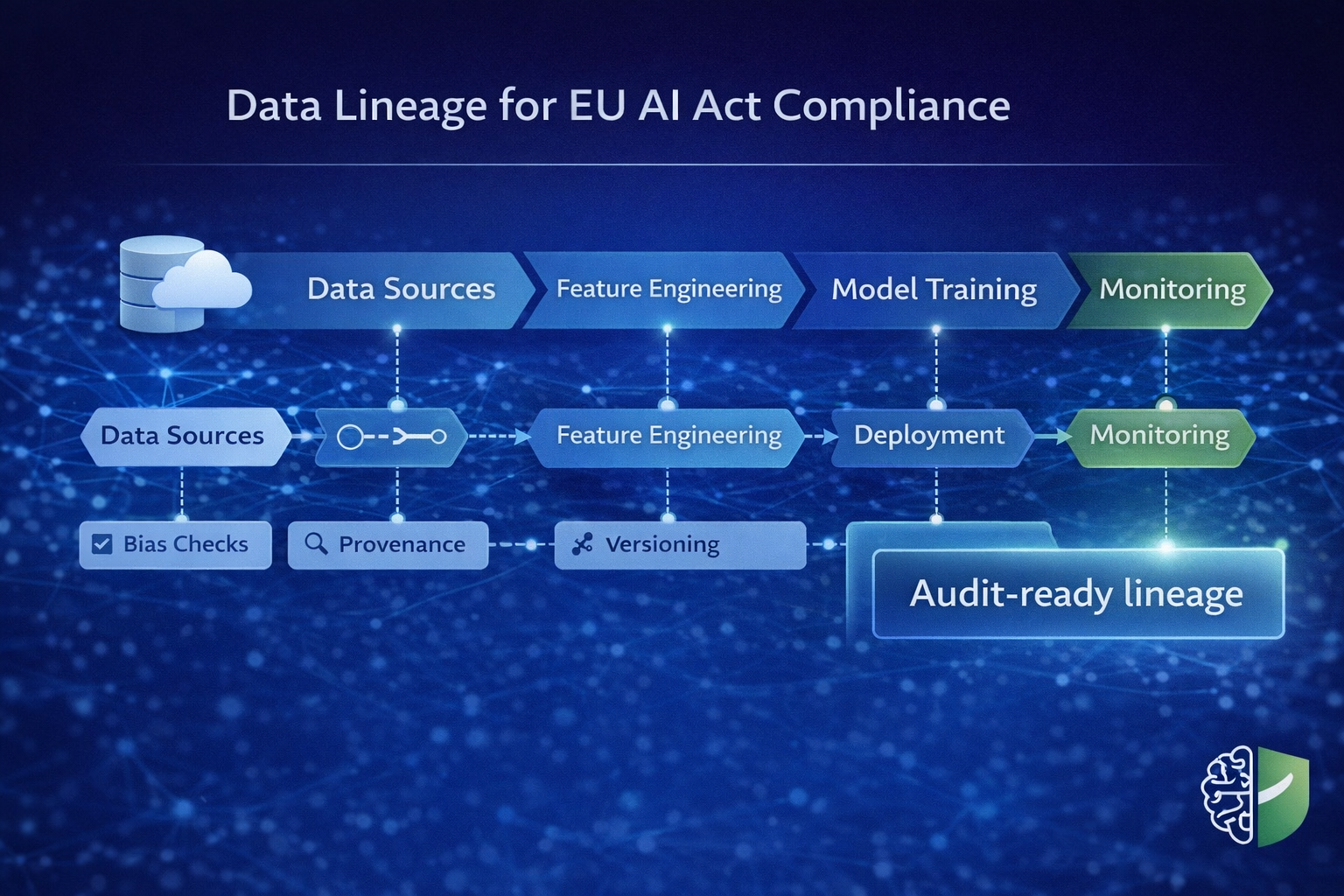
Data lineage and observability platforms form the foundation of any serious AI governance stack. Under the EU AI Act, especially Article 10, organizations must demonstrate how training and operational data flows through AI systems — from original source to transformation, feature engineering, model training, and downstream use. Without end-to-end traceability, compliance claims quickly collapse under regulatory scrutiny.
In 2026, data environments supporting AI are more complex than ever. Models are trained on data drawn from multiple internal systems, third-party providers, synthetic data generators, and continuously updated pipelines. Manual documentation cannot keep pace with these dynamics. Data lineage tools address this gap by automatically capturing metadata, relationships, and transformations across the entire data lifecycle.
At their core, these platforms answer questions regulators increasingly ask: Where did this data come from? How was it processed? Which models depend on it? What controls were applied to detect bias, errors, or unauthorized changes? For compliance teams, the ability to answer these questions quickly and consistently is no longer optional.
Leading 2026 Platforms: Atlan and Collibra
Two of the most widely adopted data lineage platforms in 2026 are Atlan and Collibra. While both address traceability, they differ in philosophy, implementation, and organizational fit.
Atlan is often described as an AI-native, collaboration-first data governance platform. It emphasizes active metadata — continuously updated information about data assets, ownership, quality signals, and usage patterns. Atlan integrates deeply with modern data stacks, including dbt, Airflow, Snowflake, BigQuery, and cloud-based machine learning pipelines. For organizations deploying AI at scale, this real-time lineage visibility is critical for maintaining audit readiness as systems evolve.
From an EU AI Act perspective, Atlan’s strength lies in its ability to surface granular lineage automatically. Column-level lineage, transformation history, and dataset ownership are captured without requiring manual intervention. This directly supports Article 10 requirements related to dataset provenance, relevance, and traceability. It also enables faster internal reviews when compliance teams need to assess whether a dataset is appropriate for a specific high-risk use case.
Collibra, by contrast, has long been positioned as an enterprise-grade governance platform. It excels in policy enforcement, structured workflows, and formal approval processes. Collibra’s visual lineage capabilities are particularly valuable for large organizations operating across regulated industries, where governance must be standardized and defensible across business units.
For EU AI Act compliance, Collibra’s strength is its alignment with formal governance structures. Data policies, access controls, and stewardship responsibilities can be explicitly defined and enforced. This makes it easier to demonstrate organizational accountability — a recurring theme in regulatory guidance. However, Collibra typically requires more upfront configuration and governance maturity to realize its full value.
Key Features That Matter for EU AI Act Compliance
Regardless of vendor, not all lineage tools are equal from a regulatory standpoint. Compliance teams should prioritize platforms that offer the following capabilities:
- Automated end-to-end lineage across data sources, transformations, and AI models
- Granular metadata capture, including column- and feature-level detail
- Integration with ML pipelines, orchestration tools, and analytics platforms
- Dataset ownership, stewardship, and accountability tracking
- Support for documenting bias assessments, data quality checks, and provenance controls
These features are essential for producing defensible evidence under Article 10. Regulators are unlikely to accept high-level narratives without supporting artifacts that show how governance controls operate in practice. Automated lineage reduces the risk of inconsistencies between what teams believe is happening and what the system actually does.
Pros and Cons in Practice
Data lineage platforms offer significant benefits, but they also introduce trade-offs that organizations must consider.
On the positive side, automated lineage dramatically reduces the time required to respond to audits or regulatory inquiries. It improves internal trust between engineering, data, and compliance teams by providing a shared source of truth. Over time, it also enables proactive risk identification — for example, detecting when a high-risk model begins consuming data from a new, unvetted source.
The primary challenges are cost and implementation complexity. Enterprise-grade platforms like Collibra can be expensive and require dedicated governance resources. AI-native tools like Atlan are faster to deploy but may require cultural change to fully leverage collaborative governance features. Smaller organizations may find the initial investment difficult to justify unless they operate high-risk systems or regulated markets.
Best Fit: Who Should Use Lineage Platforms
Data lineage and observability tools are best suited for organizations that deploy high-risk AI systems at scale, operate across multiple jurisdictions, or rely on complex data pipelines. They are particularly valuable for financial services, healthcare, employment-related AI, and public-sector use cases — all areas subject to heightened scrutiny under the EU AI Act.
For compliance leaders, lineage platforms transform traceability from a documentation burden into an operational capability. Instead of asking teams to reconstruct data histories under pressure, organizations can produce evidence on demand — a distinction that often determines how regulators interpret intent and diligence.
For a deeper exploration of why traceability has become non-negotiable for compliance leaders, see Data Lineage EU AI Act Compliance: Why CCOs Can’t Ignore Traceability.
With data traceability in place, organizations can address the next major compliance challenge: ensuring that AI systems remain robust, accurate, and aligned with regulatory expectations after deployment. This is where model monitoring and drift detection platforms become essential.
Tool 2: Model Monitoring and Drift Detection Platforms
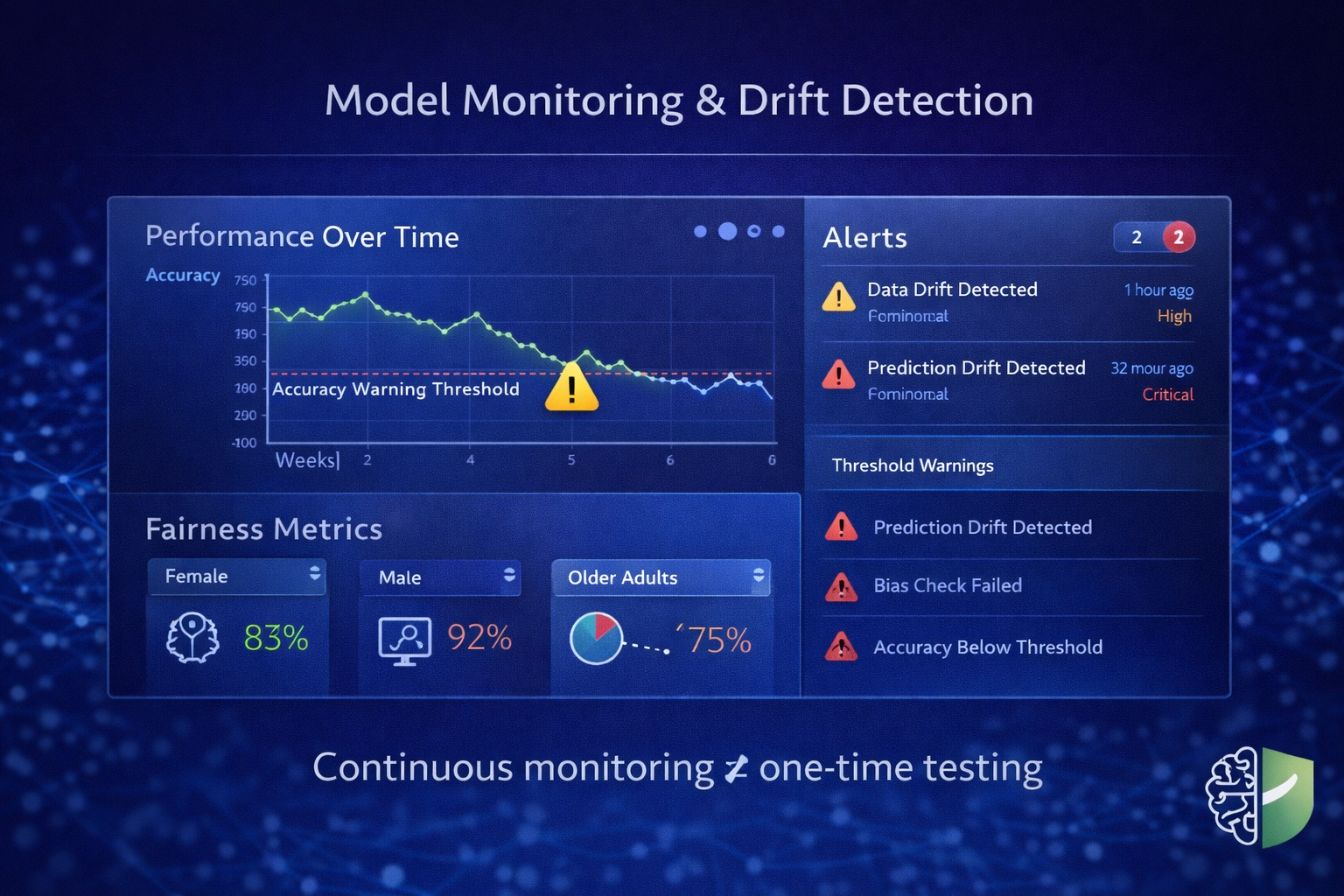
If data lineage establishes where AI systems come from, model monitoring determines how they behave over time. Under the EU AI Act, particularly Article 15 on robustness and accuracy and post-market monitoring obligations for high-risk systems, organizations must demonstrate that AI systems continue to perform as intended after deployment. This requirement makes continuous monitoring a core governance capability rather than a technical luxury.
In 2026, regulators increasingly expect organizations to move beyond static validation. AI systems operate in dynamic environments where data distributions shift, user behavior evolves, and adversarial pressure increases. Without systematic monitoring, performance degradation, bias amplification, or unsafe behavior can go unnoticed until harm occurs or enforcement action follows.
Model monitoring and drift detection platforms address this challenge by continuously tracking performance, fairness, data quality, and system behavior in production. They provide early warning signals when models deviate from expected baselines, enabling organizations to intervene before risks escalate into compliance failures.
Leading 2026 Platforms: Arize AI, Evidently AI, and AI-Native Governance Suites
Among the most widely adopted monitoring solutions in 2026 are Arize AI, Evidently AI, and governance-focused platforms such as Credo AI and Monitaur that embed monitoring into broader compliance workflows.
Arize AI is a production-grade observability platform designed for teams deploying models at scale. It offers real-time performance monitoring, drift detection, fairness metrics, and alerting across a wide range of model types. Arize integrates with popular MLOps tools such as MLflow, Kubernetes-based pipelines, and cloud monitoring systems, making it well-suited for complex, continuously updated AI environments.
From a compliance perspective, Arize enables organizations to demonstrate ongoing robustness checks rather than one-time validation. Drift reports, alert histories, and performance dashboards can be retained as evidence that monitoring controls were active and effective. This supports Article 15 requirements and strengthens post-market monitoring documentation for high-risk systems.
Evidently AI offers a more open and flexible approach, appealing to teams that value transparency and customization. With strong open-source roots, Evidently provides statistical tests for data drift, concept drift, and model performance changes. It is often used by teams that want to embed monitoring directly into internal dashboards or compliance workflows.
While Evidently may require more engineering effort to operationalize at scale, it offers a level of interpretability that compliance teams appreciate. Clear statistical explanations help bridge the gap between technical findings and regulatory narratives, particularly when explaining why remediation actions were triggered.
Governance-first platforms such as Credo AI and Monitaur integrate monitoring into a broader risk management framework. These tools combine performance tracking with policy mapping, risk registers, and compliance reporting. For organizations focused on EU AI Act alignment, this integration reduces fragmentation between engineering signals and governance documentation.
Key Monitoring Capabilities Regulators Care About
Not all monitoring metrics are equally relevant for compliance. In the context of the EU AI Act, platforms should support:
- Data drift and concept drift detection tied to deployment context
- Performance degradation tracking across protected groups where applicable
- Logging of alerts, thresholds, and remediation actions
- Support for robustness testing and stress scenarios
- Retention of historical monitoring evidence for audits
These capabilities allow organizations to demonstrate that monitoring is not superficial. Regulators are less concerned with perfect accuracy than with whether organizations identified risks, responded appropriately, and documented their actions. Continuous monitoring provides the operational backbone for that narrative.
Pros and Cons in Practice
The primary advantage of model monitoring platforms is early risk detection. Issues are identified before they cause widespread harm, regulatory complaints, or public incidents. Monitoring also improves internal confidence by making AI behavior observable rather than opaque.
The main challenge lies in implementation and interpretation. Monitoring systems can generate large volumes of signals, some of which may be noisy or context-dependent. Without clear governance processes, teams risk alert fatigue or misaligned responses. Successful organizations pair monitoring tools with defined escalation paths, ownership, and documentation standards.
Best Fit: Who Needs Continuous Monitoring
Model monitoring platforms are essential for organizations deploying high-risk AI systems, consumer-facing models, or GPAI systems with systemic impact. They are particularly important where decisions affect individuals’ rights, access to services, or financial outcomes.
Monitoring also plays a critical role in demonstrating good faith under regulatory scrutiny. When incidents occur, the presence of monitoring evidence often distinguishes organizations that proactively managed risk from those that operated blindly.
For a deeper discussion of robustness testing, adversarial evaluation, and how monitoring complements red teaming, see AI Red Teaming Explained: Adversarial Testing for Robust and EU AI Act–Compliant Systems.
With traceability and monitoring in place, organizations still face one final challenge: transforming technical signals into audit-ready evidence that regulators can review. This is where documentation and audit trail management platforms become indispensable.
Tool 3: Documentation and Audit Trail Management Platforms
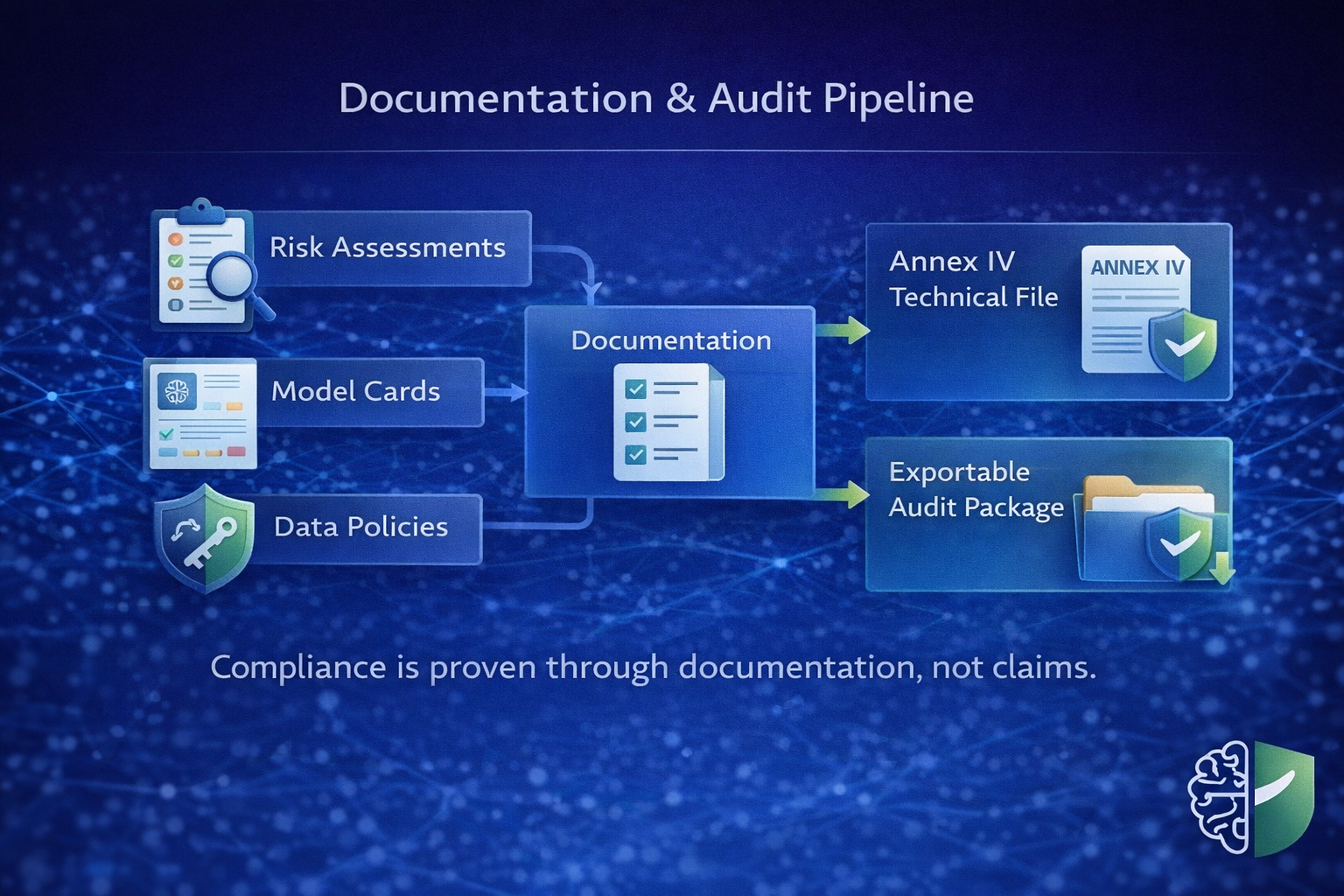
Even with strong data lineage and continuous model monitoring, many organizations fail EU AI Act audits for a simpler reason: they cannot produce clear, structured, and complete documentation on demand. Under Annex IV of the EU AI Act, high-risk AI systems must be accompanied by detailed technical documentation covering system purpose, design choices, data governance, risk management, testing, and post-deployment monitoring. This requirement makes documentation a first-class governance function, not an administrative afterthought.
In 2026, regulators are increasingly intolerant of fragmented evidence. Screenshots, spreadsheets, and scattered reports may satisfy internal teams, but they rarely meet the expectations of notified bodies or supervisory authorities. Documentation and audit trail management platforms exist to close this gap by centralizing evidence, enforcing structure, and maintaining versioned records across the AI lifecycle.
Leading 2026 Platforms: Secoda and DataGalaxy
Two platforms frequently adopted for documentation-centric governance workflows are Secoda and DataGalaxy. While both originated as data catalog and documentation tools, they have evolved to support broader AI governance and compliance needs.
Secoda focuses on AI-assisted documentation and discoverability. It combines automated metadata extraction, lineage views, and natural language documentation to reduce the manual burden of maintaining technical files. For AI governance teams, this means faster assembly of compliance artifacts without relying on ad hoc knowledge transfers between engineers and legal teams.
From an EU AI Act perspective, Secoda helps organizations maintain living documentation. As models evolve, pipelines change, or monitoring thresholds are updated, documentation can be refreshed continuously rather than reconstructed under audit pressure. This supports both Annex IV requirements and post-market monitoring obligations.
DataGalaxy emphasizes structured governance workflows and policy alignment. It offers visual data mapping, role-based documentation ownership, and compliance-oriented templates. Many organizations use DataGalaxy to formalize responsibilities, approvals, and traceability between technical assets and governance decisions.
For compliance teams preparing for conformity assessments, DataGalaxy’s strength lies in consistency. Standardized documentation structures make it easier to demonstrate that governance processes are applied systematically rather than selectively. This consistency is often as important to regulators as technical depth.
What Documentation Platforms Must Deliver for Compliance
Effective documentation platforms do more than store text. In the context of the EU AI Act, they should support:
- Version-controlled technical files mapped to specific model releases
- Clear linkage between risk assessments, mitigations, and testing evidence
- Audit logs showing who updated documentation and when
- Exportable reports suitable for notified bodies and regulators
- Alignment between technical, legal, and governance narratives
These capabilities allow organizations to respond confidently to regulatory inquiries. Instead of scrambling to assemble evidence, teams can present a coherent, pre-existing record of compliance activities.
Pros and Cons in Practice
The primary benefit of documentation platforms is audit readiness. They reduce the time, cost, and risk associated with conformity assessments and regulatory reviews. They also improve internal coordination by providing a shared source of truth for AI system information.
The main limitation is that documentation platforms depend on upstream inputs. Without solid lineage and monitoring data, documentation risks becoming descriptive rather than evidentiary. For this reason, the most effective organizations treat documentation tools as the final layer in a governance stack, not a standalone solution.
Best Fit: Who Needs Documentation Platforms Most
Documentation and audit trail platforms are essential for organizations operating in regulated sectors, deploying high-risk AI systems, or anticipating cross-border regulatory scrutiny. They are particularly valuable for compliance and legal teams that need to translate technical realities into defensible regulatory narratives.
For organizations still building foundational governance capabilities, these tools become exponentially more powerful when paired with clear governance frameworks. For a broader grounding in how documentation fits into responsible oversight, see What Is AI Governance? A Complete Guide to Responsible AI Oversight.
With data traceability, monitoring, and documentation addressed, the final challenge becomes choosing the right combination of tools. No single platform solves every problem. The next section provides a structured comparison and selection framework to help teams build an effective, EU AI Act–ready governance stack.
Emerging Layer: AI Decision Traceability and Audit Trails
While data lineage, monitoring, and documentation address critical aspects of AI governance, a growing regulatory and operational focus is emerging around a deeper question: not just what an AI system did, but why it did it.
As enforcement of the EU AI Act approaches, organizations are increasingly expected to demonstrate decision-level traceability. This includes reconstructing how specific outputs were generated, what inputs were considered, and what reasoning or system pathways led to the final outcome. In practice, this goes beyond traditional audit logs and requires structured, decision-centric records.
This emerging layer of governance focuses on capturing:
- Input context at the time of decision, including relevant data sources and features
- The model or system responsible for generating the output
- Reasoning pathways or intermediate steps where applicable
- Confidence levels and alternative outcomes evaluated
- Human oversight actions, including approvals, overrides, or escalations
These capabilities are particularly relevant for transparency obligations under Article 13, as well as broader expectations around accountability, post-market monitoring, and incident investigation. When regulators request explanations for high-risk AI decisions, organizations must be able to provide more than static documentation — they must produce verifiable, structured records of how decisions were made in context.
A distinct category of tools is beginning to emerge to address this requirement. These platforms focus specifically on AI decision audit trails, enabling organizations to capture, validate, and export decision records in a format suitable for regulatory review.
Example Platform: Compliora
Compliora is one of the early platforms exploring AI decision audit trail management. It focuses on capturing structured decision records that include input context, system outputs, reasoning chains, and regulatory classification aligned with frameworks such as the EU AI Act.
The platform also incorporates features such as multi-framework compliance mapping, audit trail immutability, completeness scoring, and exportable reports for auditor verification. These capabilities reflect an effort to bridge the gap between technical decision processes and regulatory expectations.
As this category matures, tools like Compliora illustrate how governance is expanding beyond system-level documentation toward decision-level accountability — a shift that is likely to shape future compliance requirements.
Comparison Table and Selection Framework for AI Governance Software
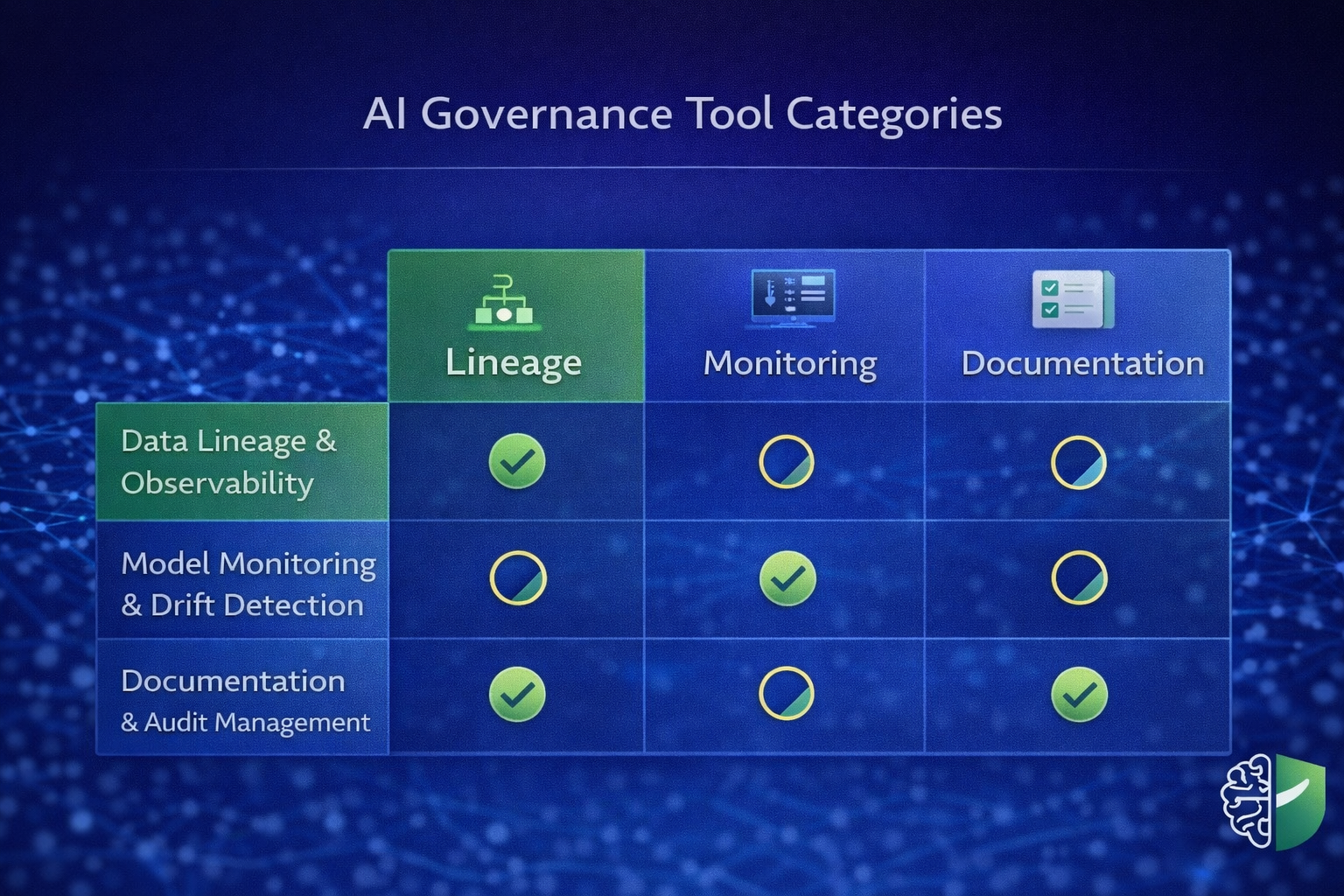
In 2026, there is no single “best” AI governance platform. The right choice depends on organizational scale, regulatory exposure, existing infrastructure, and how deeply AI systems are embedded into business operations. What matters most is assembling a governance stack that covers the full lifecycle: traceability before deployment, monitoring during operation, and documentation for regulatory accountability.
The table below summarizes how the three core categories of AI governance software align with EU AI Act obligations and typical enterprise needs.
| Category | Primary Purpose | EU AI Act Alignment | Typical Tools | Best For |
|---|---|---|---|---|
| Data Lineage & Observability | End-to-end traceability of data and pipelines | Article 10 (data governance), Annex IV documentation | Atlan, Collibra | Large organizations with complex AI pipelines |
| Model Monitoring & Drift Detection | Post-deployment robustness and performance oversight | Article 15 robustness, post-market monitoring | Arize AI, Credo AI, Evidently AI | Teams operating high-risk or GPAI systems |
| Documentation & Audit Management | Technical files, evidence tracking, audit readiness | Annex IV, conformity assessment support | Secoda, DataGalaxy | Compliance and legal teams preparing for audits |
A Practical Selection Framework for 2026
Rather than purchasing tools reactively, organizations should evaluate AI governance platforms through a structured decision lens. The following questions help narrow choices without over-investing or under-scoping compliance needs.
- Scale: How many AI systems are deployed or planned, and how interconnected are they?
- Risk Profile: Do systems fall into high-risk categories under the EU AI Act?
- Existing Stack: Can governance tools integrate with current data, ML, and monitoring infrastructure?
- Regulatory Exposure: Are systems likely to face cross-border or multi-authority scrutiny?
- Operational Maturity: Are governance processes formalized or still emerging?
Organizations with mature engineering practices but weak documentation often benefit most from audit trail platforms. Those scaling AI rapidly typically prioritize lineage and monitoring first. In practice, the most resilient approach combines all three categories over time.
For teams early in their compliance journey, grounding tool selection in a clear understanding of regulatory expectations is essential. The Engineer’s Practical Guide to EU AI Act Compliance provides a structured overview of how technical controls map to legal obligations.
The Strategic Advantage of the Right AI Governance Stack
As enforcement accelerates in 2026, AI governance software is no longer a defensive expense. When implemented thoughtfully, it becomes a strategic asset. Automated traceability reduces friction between engineering and compliance. Continuous monitoring surfaces issues before they escalate. Structured documentation builds confidence with regulators, partners, and customers.
Most importantly, the right tooling shifts governance from reactive remediation to proactive control. Organizations that invest early avoid the compounding costs described in The Real Cost of AI Non-Compliance and position themselves to scale responsibly as AI adoption grows.
Governance tools do not replace sound policy or human judgment. They amplify it. When paired with clear ownership, robust processes, and regular review, they enable teams to demonstrate—not merely claim—that AI systems are trustworthy, resilient, and compliant.
Conclusion: Choosing Tools That Scale with Regulation
In 2026 and beyond, the question is no longer whether organizations need AI governance software, but how intelligently they deploy it. Data lineage, model monitoring, and documentation platforms address different but equally critical aspects of compliance under the EU AI Act. Selecting the right combination turns regulatory pressure into operational clarity.
As AI regulation expands globally, governance requirements will continue to evolve. Organizations that choose adaptive, AI-native platforms today will be better positioned to meet future obligations without constant reinvention.
If your organization is assessing its current governance posture, a structured self-assessment can help identify gaps before tools are selected. To support that process, you can use the AI Compliance Readiness Scorecard to align tool investments with real compliance needs.
The right governance stack does more than satisfy regulators. It builds durable trust in AI systems—and that trust is quickly becoming the most valuable asset of all.
If you want to move beyond theory and translate AI governance concepts into a structured, executive-ready evaluation framework, this checklist was created specifically for that purpose.
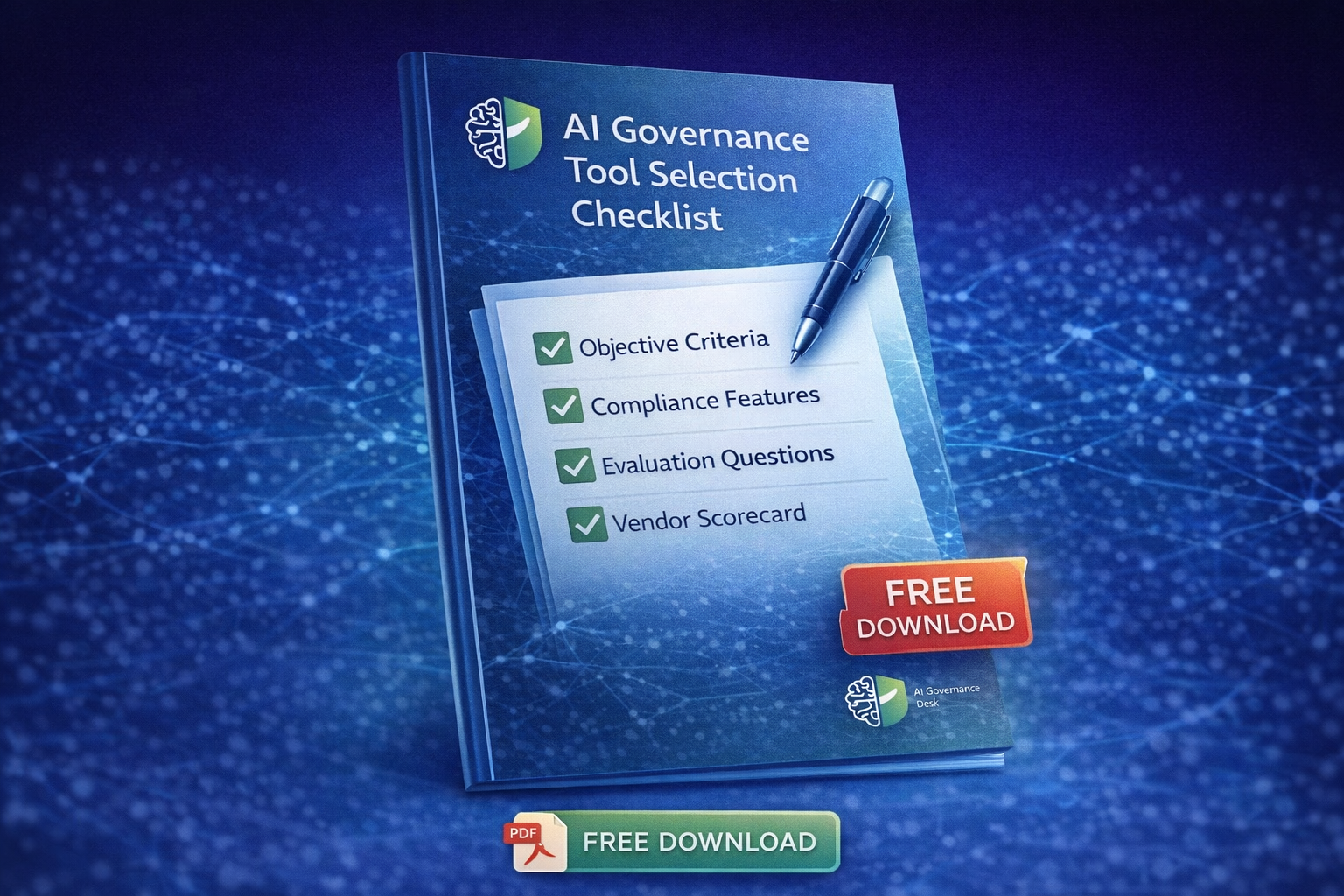
The AI Governance Tool Selection Checklist provides a practical, EU AI Act–aligned method for assessing governance platforms across data lineage, model monitoring, documentation, and AI decision traceability. It is designed for internal use by governance, compliance, risk, and AI leadership teams.
Updated to include AI decision traceability requirements (Version 1.1).
- EU AI Act–aligned governance evaluation
- Objective scoring across four core capability areas
- Audit-ready documentation and evidence tracking
- Supports defensible procurement and risk decisions
📄 Download the AI Governance Tool Selection Checklist (Version 1.1)
Version 1.1 • Internal & Advisory Use

Covering responsible AI, governance frameworks, policy, ethics, and global regulations shaping the future of artificial intelligence.